

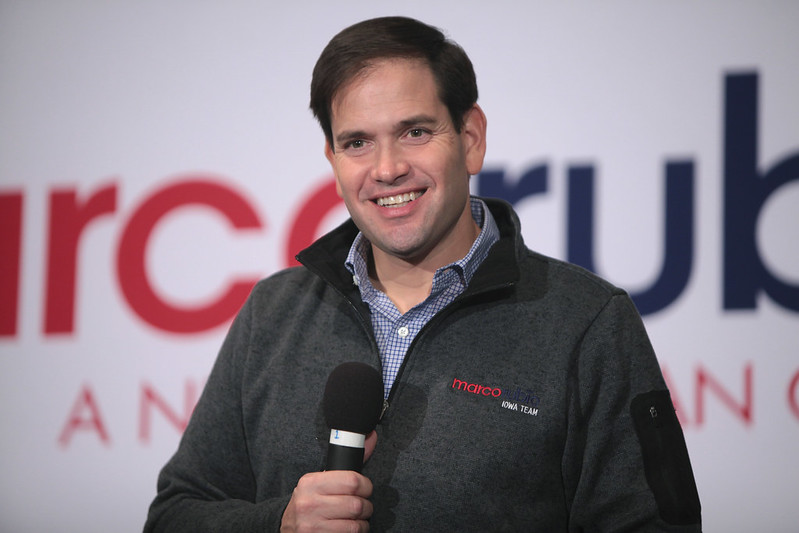
Secretary of State Marco Rubio raised fresh doubts about NATO’s future after European allies refused to allow the United States to use their bases and airspace during military operations tied to the Iran conflict.
“If now we have reached a point where the NATO alliance means we can’t use those bases to defend America’s interests, then NATO is a one way street,” Rubio argued during an interview on “Hannity,” warning that the alliance may face a serious reassessment once the war concludes.
Rubio, who noted he had long defended NATO during his time in the Senate, framed the standoff as a turning point in how the U.S. evaluates its commitments.
“America is simply in a position to defend Europe, but when we need the help of our allies, they’re going to deny us basing rights, and they’re going to deny us overflight,” he continued.
https://twitter.com/europa/status/2039241858396696731
“If NATO is simply about us having troops in Europe to defend Europe, but when we need them to allow us to use their military bases, their answer is no – then why are we in NATO?”
European governments declined to participate directly in military strikes against Iran, and several also restricted U.S. access to key operational pathways.
Reports indicated that France refused to allow U.S. military aircraft carrying supplies to Israel to pass through its airspace, marking a rare break from past cooperation.
Italy also blocked the use of a base in Sicily, while Spain closed its airspace to American planes during the same period.
The refusal drew a heated response from President Donald Trump, who described the situation as a test of loyalty among allied nations.
“They weren’t there,” Trump said, pointing to European partners who declined to assist. “So if there’s ever a big one … I don’t think they’re going to be there.”
Trump also pressed European countries over their dependence on global energy routes, especially as tensions escalated around the Strait of Hormuz.
“You’ll have to start learning how to fight for yourself, the U.S.A. won’t be there to help you anymore, just like you weren’t there for us,” he wrote on Truth Social. “Iran has been, essentially, decimated. The hard part is done. Go get your own oil!”
He followed that post with another message aimed at countries reliant on oil shipments through the strait.
“All of those countries that can’t get jet fuel because of the Strait of Hormuz, like the United Kingdom, which refused to get involved in the decapitation of Iran, I have a suggestion for you: Number 1, buy from the U.S., we have plenty, and Number 2, build up some delayed courage, go to the Strait, and just TAKE IT,” Trump wrote.
🎖️ Support our heroes abroad! 🎖️ Every HeroBox reminds a soldier they’re not forgotten ➡️➡️➡️ Let’s not leave anyone behind — DONATE NOW!!! 🇺🇸🇺🇸🇺🇸
Minutes later, Trump singled out France again, calling the country “very unhelpful” after it refused to allow flights carrying military equipment to pass overhead.
The standoff over access came as the administration suggested that securing the Strait of Hormuz may eventually fall to the countries most dependent on it.
“Look, the problem with the strait—a guy can take a mine, drop it in the water, and say, ‘Oh, it’s unsafe,’” Trump said. “That’s not for us, that’ll be for France, that’ll be for whoever is using the strait.”
He added that he had heard ships were still moving through the waterway despite ongoing concerns.
Rubio, speaking ahead of Trump’s planned address on the war, pointed to progress on the battlefield and suggested the campaign was nearing its final phase.
“We were going to destroy their air force. We have largely done that. We were going to destroy their navy, which we have largely achieved,” Rubio said, outlining the administration’s objectives. “We are on or ahead of schedule on each of those four objectives and we can see the finish line.”
He also indicated that communication channels between Washington and Tehran remain active.
“There are messages being exchanged, there are talks going on. There is the potential for direct meeting at some point,” Rubio said.
The conflict began on February 28 when U.S. and Israeli forces launched coordinated strikes against Iran, prompting retaliatory attacks from Tehran targeting Israel and Gulf states that host American bases.
Trump said the United States could bring its military campaign to a close within weeks if negotiations advance.
“We’re negotiating with them right now… again, we have had regime change,” Trump remarked, adding that preventing Iran from obtaining a nuclear weapon remains the central objective.
.@POTUS on concluding Operation Epic Fury: I would say that within two or three weeks… but we want to knock out every single thing they have. Now, it's possible that we'll make a deal before that. pic.twitter.com/tL72kmJxpf
— Rapid Response 47 (@RapidResponse47) March 31, 2026
He made clear that further military action remains on the table if talks collapse. “We’ll hit some bridges, got a couple of nice bridges in mind. But if they come to the table, that’ll be good,” Trump said.
In a separate Truth Social post, Trump claimed the U.S. was in discussions with what he described as a “new, and more reasonable” leadership structure in Iran.
“The United States of America is in serious discussions with A NEW, AND MORE REASONABLE, REGIME to end our Military Operations in Iran,” he wrote.
He paired that message with a warning tied to the Strait of Hormuz.
“Great progress has been made but, if for any reason a deal is not shortly reached, which it probably will be, and if the Hormuz Strait is not immediately ‘Open for Business,’ we will conclude our lovely ‘stay’ in Iran by blowing up and completely obliterating all of their Electric Generating Plants, Oil Wells and Kharg Island,” Trump wrote.
Defense Secretary Pete Hegseth pointed to movement in diplomatic exchanges while cautioning that the details remain fluid.
NOW: @PeteHegseth says the U.S. negotiation team has made a “productive development” in talks with Iran, but defers to negotiators on if the new regime has been easier to talk to. pic.twitter.com/k4LB0HwkL7
— Olivia Rondeau 🇺🇸 (@rondeaulivia) March 31, 2026
“I would defer to the negotiating team there. They’re the ones talking to them, but they’re getting a back-and-forth on terms, which is a productive development,” Hegseth said during a Pentagon briefing.
“We stand right there next to our negotiating team, always willing and prepared to put them in an even better position,” he added.
Iran’s foreign minister Abbas Araghchi acknowledged that messages have been exchanged between the two sides but pushed back on claims of formal negotiations.
“There is no truth to the claim of negotiations with any party in Iran,” Araghchi said, adding that communications continue through official channels without direct talks.



It is in the muslims nature to lie when it will benefit them, I would not trust anything they say.