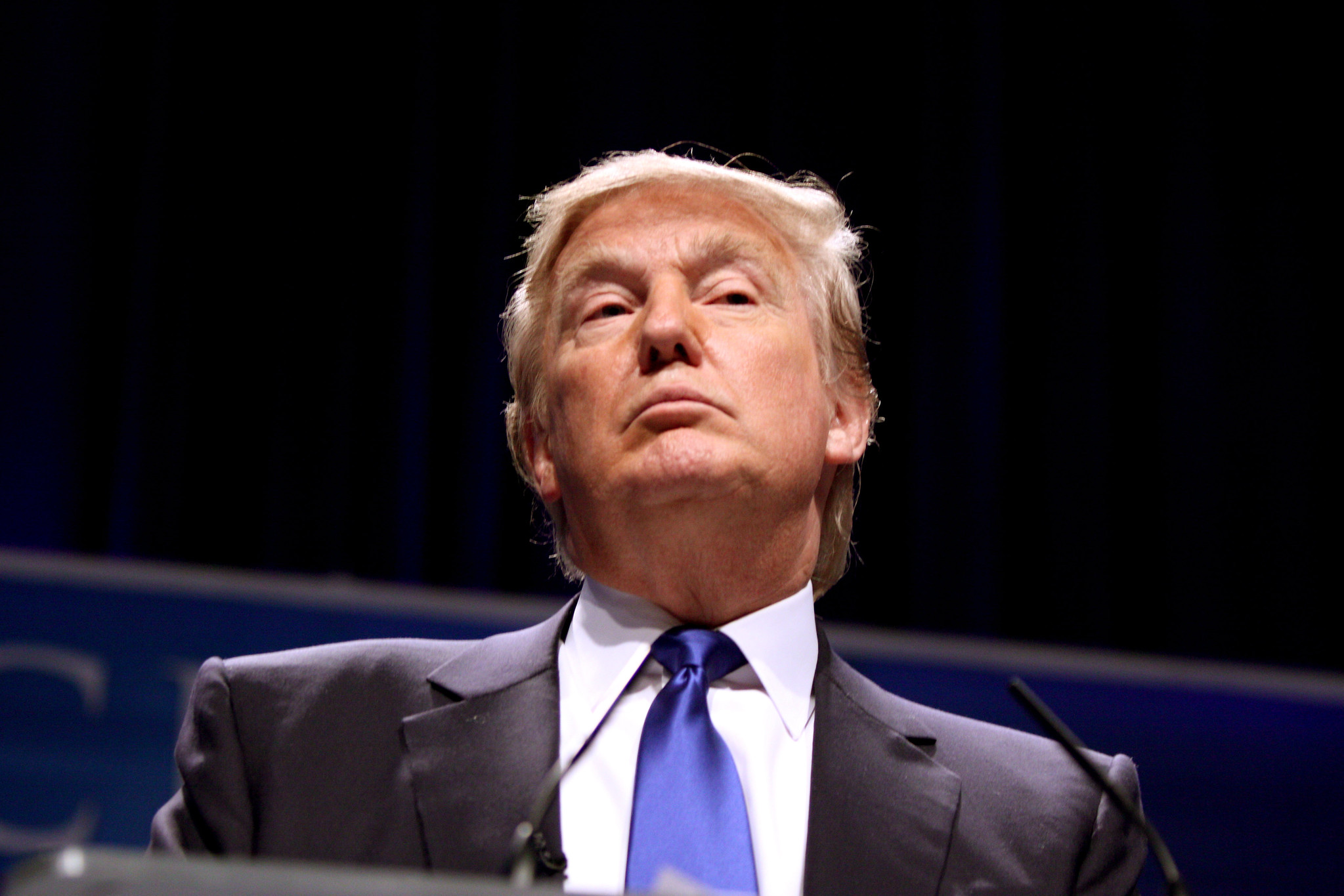
President Donald Trump is weighing whether Iran has taken enough damage, or whether it is time for the United States to hit harder.
In an Axios interview Thursday, Trump described a possible strike that would dwarf the campaign already underway against the Islamic Republic.
“I am considering a massive attack. Bigger than ever before. I am close to making a decision. We are all set for it,” Trump said.
Axios reported that the operation Trump is considering would go beyond Operation Epic Fury, the U.S. campaign that began alongside Israel earlier this year.
The president’s threat landed as U.S. operations against Iran moved through a second week following commercial shipping attacks and regional escalation.
"They are starting up again… If they do this again, the U.S. will hold Iran responsible, in that the Houthis are a Surrogate and/or Proxy of Iran, and major military punishment will be inflicted upon Iran and, of course, the Houthis, themselves" – President Donald J. Trump 🇺🇸 pic.twitter.com/aGLaW6C4nw
— The White House (@WhiteHouse) July 23, 2026
CENTCOM has been striking Iranian military infrastructure, while the Pentagon has added forces across the region in case Trump chooses to widen the fight.
Trump’s view of the negotiation track was just as combative.
Iran has signaled interest in talking, but Trump told Axios the regime “hasn’t received enough pain yet.”
🎓Support Defending Education’s mission to expose political agendas in America’s classrooms and restore quality education for all! 🎓 Help protect students and strengthen education nationwide ➡️➡️➡️ DONATE TODAY!!! 🇺🇸
He also portrayed Israel as ready to jump back in immediately if asked, saying it would join another round of strikes “in two minutes.” Trump stressed, however, that Washington does not need more military help to carry out a larger operation.
The White House has not yet moved from threat to order.
Axios cited two U.S. officials who said no new military orders have been issued and that Trump has not told the Pentagon to begin preparing an expanded offensive.
The same day, Trump was also warning Iran over attacks carried out by Yemen’s Iran-backed Houthi rebels.
Two Saudi vessels had been targeted in the Red Sea the previous night. Trump answered by making Tehran responsible for what its proxy does next.
“A year ago the United States of America attacked, very powerfully, the Houthis, for their interference with commerce and trade, by shooting at ships,” Trump wrote Thursday morning on Truth Social.
“Since that time, and during our conflict with Iran, they have acted very responsibly.”
Then he warned that the restraint had ended.
“Unfortunately, now they are starting up again, shooting at two Saudi Arabian ships last night,” Trump continued.
“Please let this TRUTH serve to represent that if they do this again, the U.S. will hold Iran responsible, in that the Houthis are a Surrogate and/or Proxy of Iran, and major military punishment will be inflicted upon Iran and, of course, the Houthis, themselves.”
Hours later, Trump moved from retaliation to repayment.
In a second Truth Social post, he declared that “any and all damages done to Ships, Cargo, or anything related thereto” would be paid for with Iranian funds under U.S. control.
“These damages may be very substantial but, nevertheless, this is the fair and equitable thing to do,” Trump wrote.
Secretary of State Marco Rubio put the administration’s Iran posture in even harsher terms when reporters asked about a phrase he attributed to Iranian Foreign Minister Araghchi.
“I saw Araghchi, the [Iranian] Foreign Minister, the other day say something about their policy is ‘an eye for an eye,’” Rubio told reporters.
SECRETARY RUBIO: "The President's policy is a head for an eye." pic.twitter.com/VcUExOl8Kr
— Department of State (@StateDept) July 23, 2026
“The president’s policy is ‘a head for an eye.’ I mean, honestly, that’s what it’s gonna be. They will pay a very heavy price for the things they’re doing.”
Rubio also accused the press of missing how much damage Iran had already absorbed.
“They’re already paying a very heavy price,” Rubio said. “You guys don’t know it because you don’t cover it; you’re not in Iran; you’re not in the street; they don’t have a free media. But they’re going to continue to pay a very heavy price; their industrial base has been decimated; their defense industrial base has been decimated.”
“They’re losing launchers; they’re losing radars every single night,” he added. “They are suffering billions of dollars in damage, and their economy’s a disaster.”
The diplomatic messages, Rubio argued, had not produced a trustworthy deal.
“But despite all that, these people who are calling us every day, begging, “Let’s do a deal,” they send us messages through other countries, third countries, I mean, they’re running out of countries to send,” he noted.
“I had countries here coming up to me, “Oh, I just spoke to the Iranians. They want to do a deal.” The problem is, every time these people do a deal, they either break it or after they make it they want to change the deal,” he added.
Congress is being pulled into the Iran push as well.
Senate Majority Leader John Thune, R-S.D., is now looking to attach Iran penalties to a Russia sanctions bill under consideration in the Senate. Trump had pushed that pairing on social media over the weekend.
“I think everybody’s fine with it because we do it anyway, Iran sanctions is something we’ve had in place the last 30 years,” Thune said to reporters.
“I’ve been having conversations with Democrats and folks on our side, and … I think we’re homing in on it.”
With senators scheduled to leave town for a month on Aug. 7, Thune said he is trying to secure a deal with Democrats to shorten floor time and move the bill quickly.
“I’m hoping we can get it teed up, and then if we can get some sort of limited time agreement to help expedite it on the floor, that would help too,” Thune added.
On Bloomberg’s “Balance of Power,” Sen. Todd Young, R-Ind., framed Trump’s position as leverage first, talks second.
“The president believes that we, of course, need to get more leverage, and then get the Iranians back to the table for a negotiated settlement,” Young said.
“But, as they have proven time and time again, they’re not feeling the heat enough. And so, unfortunately, it’s going to require the threat of more military force, perhaps more military force.”
Young said Trump still needs to make the case if the military pressure grows.
“It’s the President’s job to make the case that we need to do that and to lay out a more clear strategy on a going-forward basis,” he noted.
“But the number one goal of this conflict, we can’t lose sight of, and that is to secure the nuclear materials, remove them if possible, and then establish a verifiable enforcement regime for whatever political settlement might ultimately be agreed upon.”