

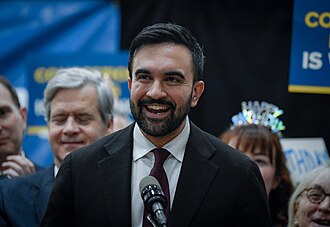
A “library card-esque” proposal for Zohran Mamdani’s planned city grocery stores has handed critics a fresh opening against the voter ID opponent.
The New York City mayor and his Democratic Socialists of America allies have long fought identification requirements at the ballot box.
Now his administration is defending a possible customer-card system for taxpayer-subsidized groceries while insisting it would not be used to verify identity, residency or income.
The issue surfaced after Mamdani promoted five government-run grocery stores that he said would sell “a collection of essential staples” for “30% cheaper” than normal retail prices.
The resale question came fast. A reporter asked how the city would stop people from loading up on cheap groceries and flipping them for profit.
Mamdani defended the program as food assistance for New Yorkers, not a resale opportunity.
“Our RFP makes very clear that this is a program for New Yorkers to be able to put food on the table, not a program for people to be able to make a quick buck through reselling,” Mamdani said.
For the mechanics of stopping bulk buying, Mamdani brought in Jeanny Pak, interim president and CEO of the New York City Economic Development Corporation.
🎓Help millions think clearly and communicate with power through Hillsdale College’s free “Classical Logic and Rhetoric course! 🎓 Expand education for liberty and equip the next generation ➡️➡️➡️ TAKE THE FREE COURSE NOW!!! 🇺🇸🇺🇸🇺🇸
Pak floated “sort of a library card-esque thing” as one way to target New Yorkers and manage buying, while keeping the program focused on “everyday New Yorkers.”
Pak did not lay out the mechanics of that system. She said only that the administration was trying to stop a resale problem before it happened.
That phrase became the problem for City Hall. Critics heard a card system for subsidized groceries from a mayor opposed to voter ID.
Mamdani’s office rejected the voter-ID comparison and framed any grocery card as an anti-resale tool.
“Comparisons to voter ID laws or the SAVE Act simply do not apply. This is not an identification system, nor is it a mechanism to verify who someone is, where they live, or how much they earn,” a Mamdani spokesperson said.
The spokesperson said the city was trying to keep discounted food from being cleared off shelves and resold, not screen shoppers by identity or residency.
City Hall also pushed back on any suggestion that shoppers would have to be New Yorkers to buy from the stores.
“To be absolutely clear: NYC Grocery stores will be open to everyone,” the spokesperson said.
On whether shoppers would have to show proof, the mayor’s office gave a flat denial.
“There will be no system to verify identity, residency, or income, and no one will be asked to show ID to shop,” the spokesperson said.
Instead, Mamdani’s office said the stores may use a “customer card” like loyalty cards at ShopRite, Food Lion or Weis.
The card would be created by the private operator of the city-run store, according to the spokesperson.
Its purpose would be to manage supply and prevent shoppers from buying large amounts of discounted staples for resale, with the savings aimed at families buying food for their tables.
That explanation did not satisfy former Los Angeles mayoral candidate Spencer Pratt, who blasted Mamdani on X.
“Racist Commie Mamdani is going to make you show ID in his markets. You want your government-subsidized arugula? Show your papers! Ask for ID to vote? BIGOT!!!” Pratt wrote on X.
Pratt kept swinging at Mamdani and his political allies.
“Are you starting to realize what disingenuous lying buffoons these commies are?”
The grocery-store argument is not the first ID fight Mamdani has faced this year.
New York City’s emergency snow-shoveling program previously required paid shovelers to register with “two original forms of ID” and a Social Security number, prompting backlash from critics who compared the rule to Mamdani’s opposition to voter ID.
House Republicans mocked the policy on X before putting the contrast in all caps.
“Let’s get this straight: in Zohran Mamdani’s socialist utopia, it takes 2 forms of ID to SHOVEL SNOW, but no ID to vote. Make it make sense,” the House Republicans wrote.
Mamdani defended the snow-shoveling paperwork as an employment requirement.
He said federal I-9 verification rules require employers, including municipal governments, to confirm identity and work authorization before workers are paid.
The grocery stores are still years from full rollout.
The first of the five publicly owned stores is expected in the Bronx by the end of 2027, with four more planned before the end of Mamdani’s four-year term. One of those locations is slated for East Harlem.
The Harlem site is expected to cost $30 million to build.
Mamdani has framed the idea as a revival of an earlier New York experiment.
In April, during his 100 Days address, he pointed to city-run markets launched in 1936 under then-Mayor Fiero LaGuardia during the Great Depression.
Mamdani said the LaGuardia-era markets helped vendors and shoppers.
“It cut overhead for pushcart vendors and lowered consumer cost,” Mamdani said.
He also quoted LaGuardia’s description of the effort as “an answer to those who said they had been forgotten,” and cited The New York Times’ summary of the plan as “City tries experiment.”
Mamdani tied the old market experiment to his pitch for cheaper groceries today.
“New York City, it is time for a grand experiment once again,” Mamdani said, arguing that government could respond to “rising prices and unaffordable groceries” the way LaGuardia responded to the Great Depression.
The stores would not operate as across-the-board discount markets. The city would subsidize certain staples while a private operator managed the store under standards set by City Hall.
“The city will subsidize a core set of food staples,” Mamdani said.
The private operator would run the store while answering to the city’s standards, according to Mamdani.
Those standards would focus on cheaper basics and worker treatment.
“These standards include requirements that at our stores, bread will be cheaper. Eggs will be cheaper,” he added. “Grocery shopping will no longer be an unsolvable equation. And workers will be treated with dignity.”
Former Mayor Eric Adams pointed out that Mamdani’s plan would “devastate the local bodegas and local stores and the local supermarkets where they employ people,” saying it was “not the right thing to do.”




Man Damn the idiot is walking into the processes he protest against. Good luck dummie!
Resale here we come!