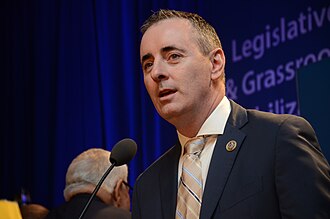
A House Republican is openly trying to shut down the Trump administration’s new $1.776 billion “anti-weaponization” fund amid growing fears it could hand taxpayer money to Jan. 6 rioters, militia members and Trump allies.
“We’re gonna try to kill it,” Rep. Brian Fitzpatrick, R-Pa., told reporters Wednesday while discussing the controversial compensation program.
Fitzpatrick said lawmakers were already exploring ways to block or dismantle the fund.
“We’re going to write a letter to the AG [attorney general] to start, but we’re considering a legislative option,” he added. “We’re trying to unpack exactly, you know, what the legal machinations are.”
The massive compensation fund emerged from a negotiated settlement between President Donald Trump and the IRS.
Under the agreement, Trump voluntarily dismissed a $10 billion lawsuit tied to leaked tax returns in exchange for the creation of the new program.
According to the Justice Department, the fund will issue monetary payouts and “formal apologies” to individuals who “suffered weaponization and lawfare” by the federal government.
The administration insists the program is designed to compensate Americans who faced politically motivated investigations and excessive prosecutions during the Biden years.
🗳️Turning Point PAC is deploying the largest ballot-chasing operation in U.S. History to secure key battleground states. 🗳️ Keep our grassroots army in the field and protect future victories! ➡️➡️➡️ DONATE TODAY!!! 🇺🇸🇺🇸🇺🇸
But critics from both parties immediately raised alarms about who could ultimately receive money.
One of the biggest concerns centers on whether people convicted in connection with the Jan. 6 Capitol riot could qualify for compensation.
Acting Attorney General Todd Blanche refused to rule out that possibility during a Senate hearing Tuesday.
“That’s not for me to set, that’s for the commissioners,” Blanche said when asked whether Oath Keepers or other Jan. 6 defendants could receive money. “Anybody in this country can apply.”
A nearly $1.8 billion DOJ-controlled fund cannot be created, defined, and distributed in the shadows.
Today, I called on Acting Attorney General Todd Blanche to provide immediate transparency on the Department’s newly announced “Anti-Weaponization Fund.”
By June 1, DOJ must… pic.twitter.com/wsKQwQQGIi
— Rep. Brian Fitzpatrick 🇺🇸 (@RepBrianFitz) May 21, 2026
Former Capitol Police officer Harry Dunn and D.C. Metropolitan Police officer Daniel Hodges, both of whom defended the Capitol during the riot, argued in a lawsuit that the program sends a dangerous message.
The lawsuit warned the fund could reward “past and potential future perpetrators of violence.”
“In the most brazen act of presidential corruption this century, President Donald J Trump has created a $1.776bn taxpayer-funded slush fund to finance the insurrectionists and paramilitary groups that commit violence in his name,” the complaint states.
Rep. Jamie Raskin, the ranking Democrat on the House Judiciary Committee, introduced legislation Wednesday aimed at blocking federal money from supporting the program.
Raskin’s proposal would also ban convicted Jan. 6 participants from receiving compensation.
“Trump is trying to commandeer nearly $1.8 billion in taxpayer funds to bankroll a slush fund for January 6 cop-beaters and aggrieved MAGA foot soldiers,” Raskin said. “This massive abuse of public money also has glaring constitutional defects.”
“Only Congress has the power to appropriate federal dollars, and we didn’t appropriate a cent for the J6 millionaire trust fund,” he added.
Even several Republicans appeared uneasy about the fund.
Senate Majority Leader John Thune openly distanced himself from the program Tuesday.
Sen. Kennedy says he has “a lot” of questions about Trump’s $1.8B “anti-weaponization” fund:
“I need to know where the money is going to come from. I need to know who would qualify. I need to know the definition of weaponization. I need to know who's been weaponized against?”
— Igor Bobic (@igorbobic) May 18, 2026
“Yeah, not a big fan. I’m not sure exactly how they intend to use it. But my understanding is that was just announced,” Thune told reporters. “I don’t see a purpose for it.”
Sen. John Kennedy, R-La., also expressed skepticism. “I need to know where the money is going to come from,” Kennedy said.
“I need to know who would qualify. I need to know the definition of weaponization. I need to know who’s been weaponized against?”
The White House, however, has aggressively defended the compensation program.
Vice President JD Vance accused the media of deliberately distorting the fund’s purpose during a White House briefing Tuesday.
“This is about compensating Americans for the lawfare that we saw under the last administration,” Vance said.
“Anybody can apply for it. Republicans can apply for it, Democrats can apply for it.”
Vance also rejected accusations the program was secretly designed to benefit Trump or his family.
“Is $1 of this money going to the Trump administration? No,” Vance said “Is $1 of this money going to Donald Trump personally? No.”
Still, Vance stopped short of promising Jan. 6 defendants would automatically be excluded.
“We’re not trying to give money to anybody who attacked a police officer,” Vance said.
“We’re trying to compensate people where the book was thrown at them, they were mistreated by the legal system.”
Trump himself attempted to create some distance from the fund earlier this week.
“I wasn’t involved in the whole creation of it and the negotiation, but this is reimbursing people that were horribly treated,” Trump told reporters Monday.
The settlement contains other provisions already drawing scrutiny.
According to a memo signed by Blanche, the IRS is permanently barred from auditing Trump’s prior tax returns or pursuing certain claims involving Trump, his businesses or family members.
Fitzpatrick signaled Wednesday that lawmakers would likely target those provisions as well.
“Yeah, you can’t do that,” he said when asked whether future legislation could address the audit protections.
Meanwhile, the first official claim for compensation has already been filed.
Michael Caputo, a longtime Trump ally and former Health and Human Services spokesperson during Trump’s first administration, is seeking $2.7 million from the fund.
Caputo claims he was targeted by the Biden administration over investigations tied to Crossfire Hurricane and the broader federal probe into alleged ties between Trump associates and Russian interference during the 2016 election.