

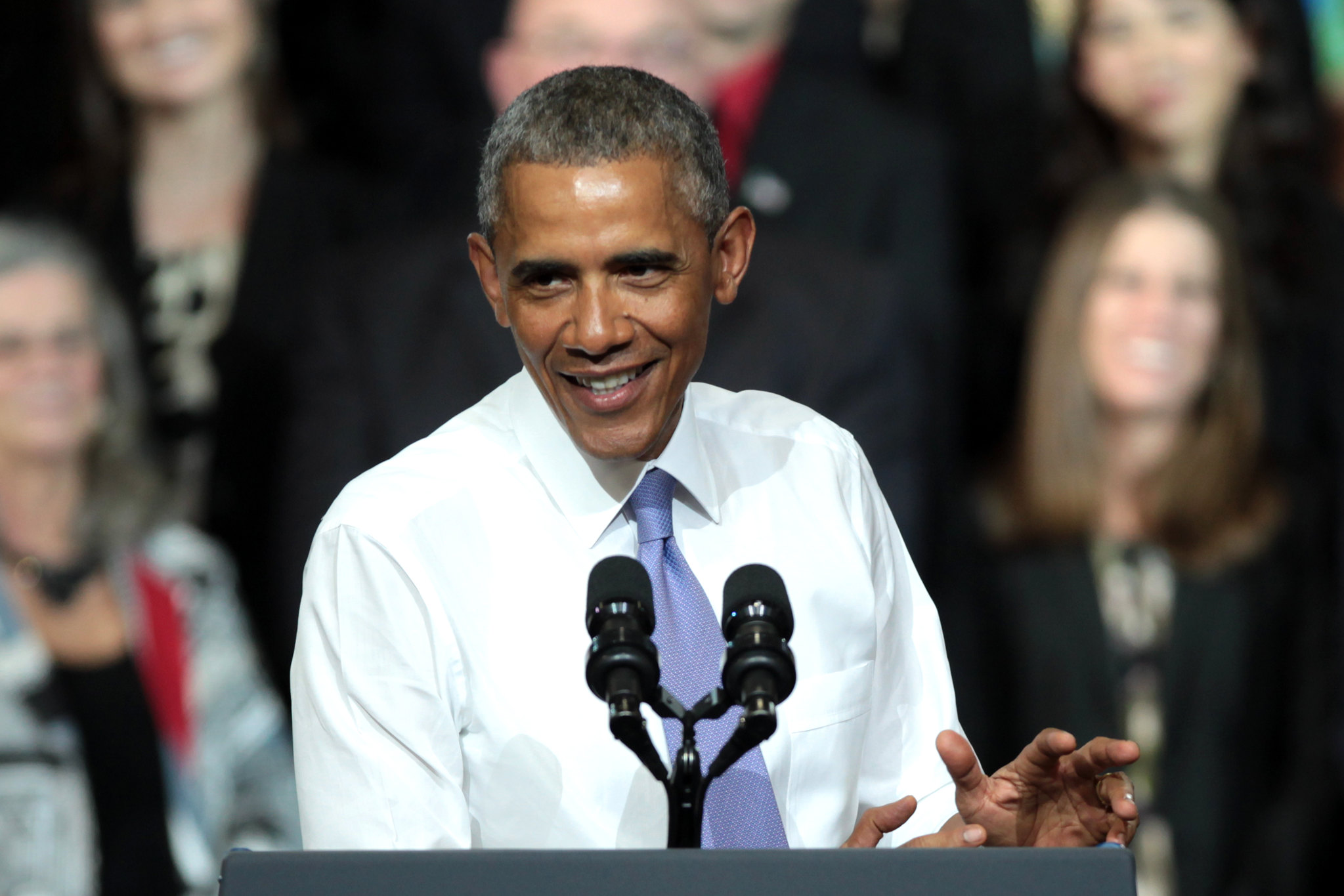
Former President Barack Obama took a shot at President Donald Trump for pursuing war with Iran instead of diplomacy, arguing his administration contained Tehran “without firing a missile.”
Obama made the remarks during an appearance on “The Late Show,” where he pointed to the 2015 Joint Comprehensive Plan of Action as proof that diplomacy, rather than military escalation, could restrain Iran’s nuclear ambitions.
“We went about trying to negotiate a diplomatic agreement that would get the enriched uranium out of Iran, that would assure they could not get to a nuclear weapon without us knowing about it … and that there were mechanisms in place to enforce it and verify it,” Obama told Stephen Colbert.
“And we pulled it off without firing a missile,” he remarked.
Obama acknowledged his administration considered military action during negotiations but insisted force was treated as a “last resort.”
“My basic theory was that Iran couldn’t become a nuclear state, that the regime itself was murderous, oftentimes towards its own people, engaged in state-sponsored terrorism, was a threat to the United States and allies of ours,” Obama continued.
“So the idea that they would have nuclear weapons would be extraordinarily dangerous.”
At the same time, Obama argued Tehran still operated with a “survival instinct,” warning that military action inevitably kills civilians.
🪖Discover what it takes to turn defeat into victory in this FREE eBook on history’s “savior generals” 🪖 Learn how exceptional leadership can change the course of war!➡️➡️➡️ Download your FREE copy NOW!!! 🇺🇸🇺🇸🇺🇸
The former president said the agreement dramatically reduced Iran’s uranium stockpile and imposed inspection mechanisms that prevented the regime from secretly advancing toward a nuclear weapon.
“There’s no dispute that it worked, and we didn’t have to kill a whole bunch of people or shut down the Strait of Hormuz,” Obama contended.
Trump withdrew the United States from the nuclear agreement in 2018, blasting it as “a horrible, one-sided deal that should have never, ever been made.”
Critics of the JCPOA argued its sunset provisions merely delayed Iran’s nuclear ambitions rather than ending them.
Since the American withdrawal, Iran has dramatically accelerated uranium enrichment. The original deal capped enrichment below 4 percent.
Iran now possesses uranium enriched to 60 percent purity, which is far closer to the 90 percent threshold generally associated with weapons-grade material.
Trump has repeatedly insisted Iran cannot retain highly enriched uranium under any future agreement, a position Iranian officials reportedly continue rejecting as negotiations surrounding the war remain deadlocked.
Obama’s remarks landed as the administration faces intensifying scrutiny over the military and economic cost of the now eleven-week conflict.
Defense Secretary Pete Hegseth spent much of this week publicly pushing back against concerns that the war has badly strained American weapons stockpiles.
During congressional hearings Tuesday, Hegseth rejected claims that U.S. munitions reserves have been dangerously depleted.
“First of all, the munitions issue has been foolishly and unhelpfully overstated,” Hegseth told House appropriators.“We know exactly what we have. We have plenty of what we need.”
But lawmakers from both parties have raised alarms about the pace of weapons consumption during the war.
Senate Armed Services Committee Chairman Roger Wicker warned Tuesday that Army stockpiles were “under extreme strain.”
The White House is also reportedly preparing to request between $80 billion and $100 billion in supplemental war funding from Congress, with much of the money expected to replenish missiles and advanced weapons systems consumed during the fighting.
According to reports, the United States has burned through thousands of missiles since the conflict began Feb. 28.
Officials have reportedly drawn heavily from Tomahawk cruise missiles, Patriot interceptors, Precision Strike missiles and ATACMS inventories.
Questions surrounding the war intensified further after intelligence assessments reportedly concluded Iran still retains roughly 70 percent of both its mobile missile launchers and its prewar missile stockpile.
The assessment appeared to undercut public claims that Tehran’s missile capabilities had been largely destroyed.
Democratic lawmakers repeatedly pressed Hegseth and Joint Chiefs Chairman Gen. Dan Caine over those discrepancies during hearings this week.
Sen. Chris Murphy demanded answers about how Congress and the public could judge the success of the campaign if officials refused to disclose the extent of Iran’s remaining capabilities.
“How do we or the American public assess the success of the mission when you’ve stated publicly the purpose of the mission is to destroy their missile and drone capability?” Murphy asked.
“All of our battle damage assessment matters are classified,” Caine responded. “It would be inappropriate for me to comment in this forum on that.”
The administration’s messaging has also become tangled in disputes over classified information.
Sen. Mark Kelly said after receiving Pentagon briefings that it was “shocking how deep” the United States had pulled from weapons reserves.
“This president got our country into this without a strategic goal, without a plan, without a timeline,” Kelly said during an interview. “And because of that, we’ve expended a lot of munitions.”
Hegseth later accused Kelly of improperly disclosing classified information.
While Democrats focused on the cost and sustainability of the conflict, Republican allies of the president struck a dramatically more aggressive tone.
Sen. Rick Scott openly urged Trump to escalate further and finish off Iran’s remaining military infrastructure.
“We can’t wait for Iran to rebuild. We can’t wait for Iran’s next attack,” Scott wrote in an op-ed published by The Daily Wire.
“The radical Islamist regime is hearing its death knell. It’s time to deliver the final blow.”
Scott framed the current moment as a historic opportunity to permanently dismantle Iran’s nuclear capabilities.
“This is a once-in-a-generation chance,” he wrote.
The Florida senator also attempted to reassure Americans worried about rising fuel prices and economic instability tied to the conflict.
“I grew up in a poor family,” Scott wrote. “I understand how this squeezes a family’s budget and how unfair it feels when prices rise.”
Scott’s remarks drew additional attention after Trump himself said before departing for China that he does not “think about Americans’ financial situations” when negotiating with Iran.
The fragile ceasefire remains under strain as diplomatic negotiations continue behind the scenes.
Iran recently submitted a 14-point peace proposal to the United States calling for a phased drawdown of the war, sanctions relief, U.S. troop withdrawals and a new framework governing the Strait of Hormuz.
Trump rejected the proposal Sunday. “TOTALLY UNACCEPTABLE,” the president wrote.
Iranian Speaker of Parliament Mohammad Bagher Qalibaf responded with a warning of his own, saying American taxpayers “will pay for it” if the United States refuses the proposal.
Meanwhile, Secretary of State Marco Rubio said the administration plans to pressure China into taking a more active role in resolving the crisis as Trump meets with Chinese President Xi Jinping.
Speaking aboard Air Force One during the trip, Rubio argued the conflict threatens China’s own economic interests because of instability surrounding the Strait of Hormuz.
“It’s in their interest to resolve this,” Rubio said.
“We hope to convince them to play a more active role in getting Iran to walk away from what they’re doing now.”
Rubio said the administration believes Beijing faces growing economic pressure as the crisis disrupts global shipping and trade.
“Economies are melting down because of this crisis in the Strait,” Rubio said.
“They’re going to be buying less Chinese product, and the Chinese exports are going to drop precipitously.”
Trump’s meeting with Xi marks the first face-to-face summit between an American president and the Chinese leader since Trump visited Beijing nine years ago.

Hey obama, President Trump didn’t give Tehran billions in cash, in the middle of the night, enabling them to buy what they wanted to make a nuke.
And he didn’t send 1,700 U.S. Marines into combat in eastern Kenya to guard soros’ oil fields.
And he didn’t send black panthers to Philadelphia polling places to threaten elderly White voters.
And he didn’t attack syria.
You did same Obama but your wars were longer vs Our Iran War today