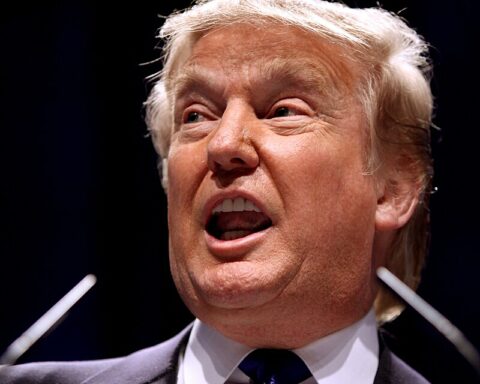
President Donald Trump mixed off-the-cuff remarks with policy moves Friday, joking about the United States “taking over” Cuba while his administration rolled out tougher sanctions on Havana and confirmed plans to pull thousands of U.S. troops out of Germany.
Speaking at the Forum Club of the Palm Beaches, Trump veered into a riff about the island as he acknowledged attendees.
“And he comes from, originally, a place called Cuba, which we will be taking over almost immediately,” Trump said. “Cuba’s got problems. We’ll finish one first. I like to finish a job.”
He extended the bit with a hypothetical show of force, sketching out how a U.S. carrier might be used as leverage.
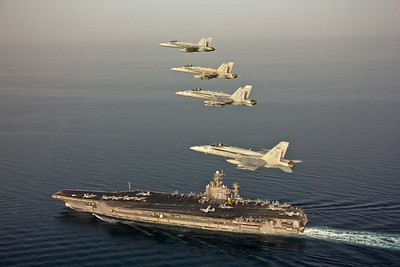
“On the way back from Iran, we’ll have one of our big — maybe the USS Abraham Lincoln aircraft carrier — the biggest in the world,” he suggested. “We’ll have that come in, stop about 100 yards offshore, and they’ll say, ‘Thank you very much, we give up.’”
Trump has previously spoken about taking over the island nation, telling reporters in March, “Whether I free it, take it, I think I can do anything I want with it.”
Hours before the remarks, the White House announced an executive order widening sanctions aimed at Cuba’s government and its backers.
The measure targets “agents, officials, or material supporters” tied to Havana’s leadership, along with individuals connected to the country’s security apparatus or implicated in corruption and human rights abuses.
🎇Honor America’s 250th Anniversary!!!🎇 Get your 2026 Heritage Foundation commemorative membership card ➡️➡️➡️ ACTIVATE YOUR MEMBERSHIP NOW!!! 🇺🇸🇺🇸🇺🇸
The order also moves to squeeze Cuba’s access to international finance. It authorizes penalties against foreign banks and entities that conduct significant transactions with sanctioned parties, effectively extending U.S. restrictions beyond its borders.
In a statement, the White House framed the move as a response to security concerns.
“The President is addressing the national security threats posed by the communist Cuban regime by taking decisive action to hold the Cuban regime, and those that perpetuate it, accountable for its support of hostile actors, terrorism, and regional instability that endanger American security and foreign policy,” the release stated.
The sanctions come as Cuba’s economy continues to deteriorate following the loss of key oil shipments earlier this year, a shift that has deepened shortages and fueled a humanitarian crisis.
Even as pressure increased, Cuban President Miguel Díaz-Canel signaled he was not ruling out engagement with Washington.
“I think we can have an approach in terms of what is possible and what is difficult,” Díaz-Canel told NBC’s Kristen Welker in April.
“I think dialogue and deals with the U.S. government are possible, but they’re difficult.”
Diplomatic channels have remained active in the background. The State Department sent a delegation to the island in April to explore options for addressing the crisis, according to reporting cited in the administration’s outreach.
Separately, the Pentagon confirmed a significant change to U.S. force posture in Europe, announcing that roughly 5,000 troops will be withdrawn from Germany over the coming months.
“The Secretary of War has ordered the withdrawal of approximately 5,000 troops from Germany,” chief Pentagon spokesman Sean Parnell announced.
“This decision follows a thorough review of the Department’s force posture in Europe and is in recognition of theater requirements and conditions on the ground. We expect the withdrawal to be completed over the next six to twelve months.”
The reduction will affect a brigade combat team and supporting units, and it cancels a previously planned deployment of a long-range fires battalion that had been scheduled to arrive later this year.
Officials described the shift as part of a wider realignment that prioritizes the United States, the Western Hemisphere and the Indo-Pacific, while scaling back the expanded footprint in Europe that followed Russia’s 2022 invasion of Ukraine.
Germany currently hosts about 35,000 active-duty U.S. personnel, more than any other European country.
Trump has repeatedly criticized NATO allies over defense spending and strategic priorities, arguing that European governments rely too heavily on U.S. military support.
He has also taken aim at German Chancellor Friedrich Merz, accusing him of misjudging the threat posed by Iran and failing to back U.S. efforts in the region.
“He’s doing a terrible job and he’s got a big problem with Ukraine, because they’re in that mess,” Trump said earlier Friday, escalating a public feud between the two leaders.
In a separate social media post, Trump argued that Merz’s position on Iran could have far-reaching consequences.
“The Chancellor of Germany… thinks it’s OK for Iran to have a Nuclear Weapon. He doesn’t know what he’s talking about!” Trump wrote, adding that if Tehran obtained such a capability, “the whole World would be held hostage.”
Merz has pushed back on that characterization, accusing Iran of stalling negotiations while also criticizing Washington’s approach to the conflict.
“An entire nation is being humiliated by the Iranian leadership, especially by these so-called Revolutionary Guards,” he said during a speech earlier in the week. “And so I hope that this ends as quickly as possible.”
He also questioned the long-term strategy behind recent military actions.
“If I had known that it would continue like this for five or six weeks and get progressively worse, I would have told him even more emphatically,” Merz said, describing conversations with Trump.
The troop drawdown will bring U.S. force levels in Europe closer to where they stood before the 2022 buildup, which officials have described as a temporary response to the war in Ukraine.
Pentagon officials indicated the withdrawal will unfold over six to twelve months, with units redeployed or reassigned as part of the shift.