

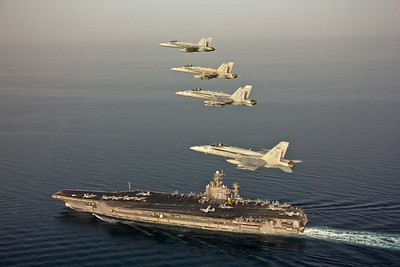
A dispute over how long U.S. forces can remain engaged against Iran without congressional approval intensified Friday, with Sen. Todd Young warning the administration would need authorization if military operations resume.
Young’s comments came as officials argued that a temporary ceasefire effectively halted the 60-day clock under the War Powers Resolution, a position that would delay any requirement for lawmakers to weigh in.
“The purpose of the War Powers Act was to assert the constitutional responsibility of Congress to declare war,” the Indiana Republican said in a statement.
“We must ensure that the people, through their elected representatives, weigh in on whether to send our military into combat. This should not be controversial.”
🚨 GOP SEN. YOUNG: TRUMP SHOULD WORK WITH CONGRESS ON ANY FUTURE IRAN STRIKES
Sen. Todd Young says Trump needs congressional approval for Iran action
Congress's constitutional role in declaring war is at stake
Young cites the War Powers Act pic.twitter.com/CO7t8gFLY0— AI WIRE (@AIDEEPLEEK) May 2, 2026
The timeline has been central to the debate since President Donald Trump formally notified Congress in early March about the operation, triggering the countdown that limits military engagement without legislative approval.
Under the 1973 law, presidents must report military action within 48 hours and cannot sustain combat operations beyond 60 days without authorization, though a short extension is allowed to facilitate withdrawal.
Administration officials, however, say the situation changed once fighting stopped.
A senior official said the campaign was effectively “terminated” when Trump announced a truce with Tehran in early April, arguing that the pause reset the clock for purposes of the law.
Defense Secretary Pete Hegseth echoed that view during a Senate Armed Services Committee briefing.
🪖Discover what it takes to turn defeat into victory in this FREE eBook on history’s “savior generals” 🪖 Learn how exceptional leadership can change the course of war!➡️➡️➡️ Download your FREE copy NOW!!! 🇺🇸🇺🇸🇺🇸
“We are in a ceasefire right now, which our understanding means the 60-day clock pauses, or stops in a ceasefire,” Hegseth stated.
House Speaker Mike Johnson also leaned toward that interpretation, pointing to the absence of active combat.
“I don’t think we have an active, kinetic military bombing, firing or anything like that,” Johnson told NBC News. “Right now, we are trying to broker a peace. We are not at war.”
Young did not directly dispute the ceasefire itself but made clear he expects the administration to involve Congress if hostilities pick up again.
He said the current posture should mean “there should be no hostilities moving forward,” adding that lawmakers would need to be consulted if that changes.
Trump addressed the issue in a letter to Congress, stating that there has been no exchange of fire since early April while warning that the threat from Iran has not been resolved.
🚨 NOW — REPORTER: Will you do new strikes on Iran?
PRESIDENT TRUMP: "WHY would I tell you that?!"
The fake news never learn! 🤣🔥 pic.twitter.com/hyz57H2cwO
— Eric Daugherty (@EricLDaugh) May 1, 2026
“On April 7, 2026, I ordered a 2-week ceasefire. The ceasefire has since been extended. There has been no exchange of fire between United States Forces and Iran since April 7, 2026. The hostilities that began on February 28, 2026, have terminated,” the president wrote.
He also noted that U.S. forces remain positioned in the region.
“Accordingly, the Department of War continues to update its force posture in the AoR in select countries, as necessary and appropriate, to address Iranian and Iranian proxy forces’ threats and to protect the United States and its allies and partners,” Trump added.
Despite the legal debate, Trump indicated he is not inclined to seek congressional authorization.
“It’s never been sought before,” he told reporters at the White House. “There’s been numerous, many, many times and nobody’s ever gotten it before. They consider it totally unconstitutional.”
He dismissed lawmakers who have pressed the issue, saying previous administrations have operated the same way.
“Many presidents, as you know, have gone and exceeded it,” Trump said, arguing that the limit has long been contested.
Some Republicans have taken a different stance. Sen. Susan Collins voted for a war powers resolution aimed at halting military action, breaking with much of her party even though the measure ultimately failed.
“That deadline is not a suggestion; it is a requirement,” Collins said in a statement explaining her vote.
Sen. Rand Paul joined her in backing the resolution, while other Republicans declined to do so.
Sen. John Curtis, who had previously signaled concern about the timeline, did not break ranks in the latest vote.
Alongside the legal fight, diplomatic efforts remain underway as both sides test whether a broader agreement is possible.
Trump said he has presented Iran with what he described as a final proposal but expressed skepticism about reaching a deal.
🇺🇸🇮🇷 US President Trump says he is "not satisfied" with Iran's new peace proposal.pic.twitter.com/vVyapplHRp
— Jackson Hinkle 🇺🇸 (@jacksonhinklle) May 1, 2026
“[I’m not sure] we’re going to get a deal,” he said, pointing to what he described as divisions within Iran’s leadership.
“They all want to make a deal but they’re all messed up,” Trump added. “In Iran, the leadership is very disjointed. It’s got two to three groups, maybe four, and it’s a very disjointed leadership.”
He said Iran has made some progress in negotiations but has not met U.S. expectations.
“Iran wants to make a deal, but I’m not satisfied with it,” Trump said.
When asked what remains unresolved, he said Tehran is seeking concessions he cannot accept.
“[They’re] asking for things I can’t agree to,” he said.
The negotiations are tied in part to efforts to reopen the Strait of Hormuz, a critical shipping route that carries a significant share of global oil supplies.
Iran has reportedly submitted a new proposal through intermediaries, though details have not been made public.
The White House has maintained that any agreement would require Iran to suspend its nuclear program and relinquish enriched uranium, conditions that remain a major point of contention.





Where was this approval when Obama attacked Syria, or when he sent 1700 Marines to guard soros’ oil fields in africa?
Funny how we ignore history. According to Mary L. Dudziak in her book, The Gloss of War: Revisiting the Korean War’s Legacy, “President Truman did not seek congressional authorization for the military action under domestic law, and Congress did not enact a declaration of war or authorization for use of military force.” If memory serves, the Korean War/Conflict lasted quite a bit longer than 60 days. Obama and Geo. W. Bush both had military actions that exceeded this window of time without Congressional approval.
All for DC Swamp power only screw the Exec Branch