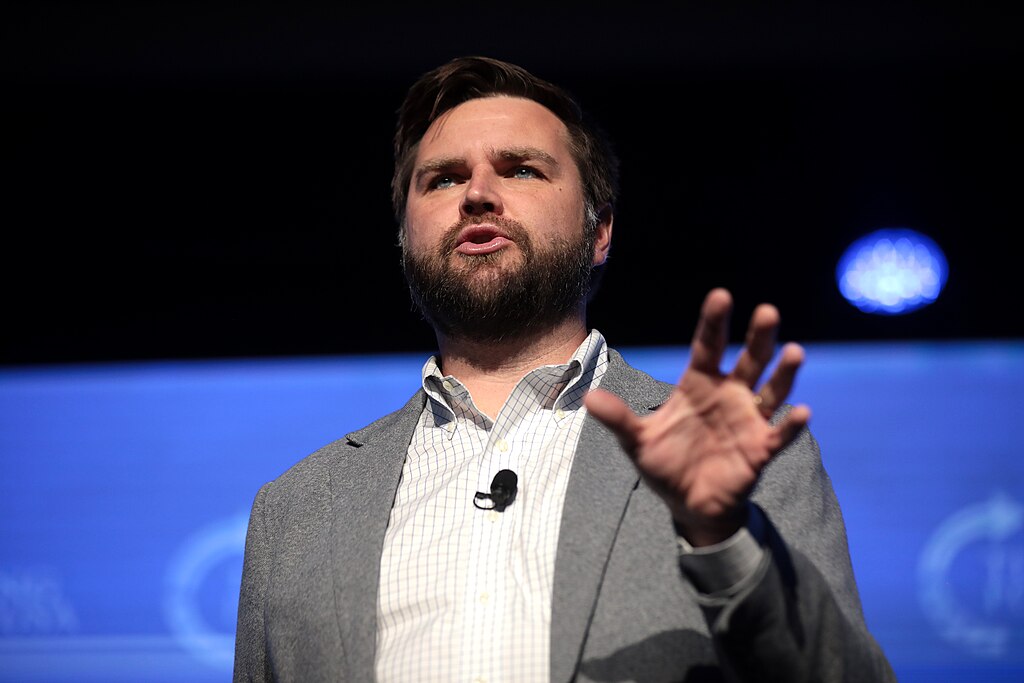
Vice President JD Vance told Americans they did not need to build bunkers or stockpile supplies as a United Airlines outage disrupted travel Monday.
On Fox News, Laura Ingraham pointed to the Pentagon’s preparations to operate off the grid and asked whether Americans should be preparing for something after two weeks of disruptions.
Vance answered that “We don’t see a crisis coming down” even as the administration prepares for emergencies.
The question had already come up in the vice president’s private conversations. Vance told Ingraham that “A lot of my friends have reached out” to ask whether to put aside food and water or build a bunker.
He called the military preparations “just basic good government” and credited President Donald Trump with reinvesting in the country’s ability to handle a crisis.
The vice president said the goal was to prevent the worst outcomes while keeping the government ready to respond if they occurred.
He summed up his view of those preparations with “That doesn’t mean crisis is around the corner” in the interview.
United briefly grounded its flights across the country Monday. The airline apologized on X for what it called a “widespread system outage” and asked passengers with upcoming trips to check the app for updates.
🎓Support Defending Education’s mission to expose political agendas in America’s classrooms and restore quality education for all! 🎓 Help protect students and strengthen education nationwide ➡️➡️➡️ DONATE TODAY!!! 🇺🇸
In its message to travelers, the airline said its teams were “working hard to get things back up and running as soon as possible” following the outage.
Passengers whose flights could not take off posted complaints online. The carrier reported that some departures were delayed while aircraft already in the air and United Express services continued without interruption.
A spokesperson reported “no indication that this was a cybersecurity-related issue” in connection with the interruption.
Monday’s airline disruption came days after a technical failure prompted the Federal Aviation Administration to halt departures nationwide on Friday.
Air travel was one of several services disrupted over the same period. On Friday, Microsoft users had trouble accessing Outlook, Teams and Copilot.
On Monday, thousands of users reported banking problems to Down Detector, which tracks complaints as they come in. Customers of Wells Fargo, Capital One, Bank of America and Chase reported trouble signing in or moving money.
At the White House on Monday, Trump blamed the FAA ground stop on equipment he said was decades overdue for replacement. Friday’s ground stop led to thousands of cancellations and disrupted travel for more than a million passengers.
“We have old, broken equipment,” the president said before leaving for Asia aboard the new Air Force One plane gifted by Qatari officials. He put the age of some of the equipment that failed at 55 years.
Trump said the old equipment had “a heart attack” on Friday. He maintained the government could install replacements while taking out the old equipment, with little disruption.
Vance called for Congress to address the aviation infrastructure in a reconciliation bill during the lame duck session. He argued that underinvestment had left the system in need of repairs and disputed the idea that fixing it would cost a great deal.
The vice president’s case for congressional action was that “This is not an expensive problem, but we do need to reinvest in rebuilding that infrastructure” now.
By Vance’s estimate, the administration has replaced about 70 percent of the equipment that needed replacing. He credited the administration with making that progress despite what he characterized as limited resources from Congress.
Homeland Security Secretary Markwayne Mullin addressed the cyberattack question separately Monday on Fox News’ Hannity. He described the disruptions as “individually unrelated” in explaining why he saw no common cause.
Mullin told Hannity “I can tell you with 98% certainty we’re not seeing the cyberattack” in describing what officials had seen. He pointed to the absence of evidence he would expect in a breach.
The secretary told Hannity there were no “footprints going in” to suggest an intrusion. He reported the same result looking for traces going out, and said there was no sign connecting the disruptions.
His message to viewers began with “Well, breathe” before he addressed the security of the country and its banks. He assured host Sean Hannity that the homeland and banking system were secure and that the government could respond quickly.
Mullin pointed to the strain that newer technology puts on older systems, including the backups designed to keep services running during a failure. In his account, backup systems designed for older technology can be overwhelmed by the demands of newer systems.
He also relayed a theory from a technology expert who had briefed him earlier Monday. The expert suggested that what Mullin called “super intelligence” might have contributed to the problems, an explanation the secretary found plausible.
Mullin compared the theory to a change order on a house, where one alteration forces changes elsewhere. He said the expert had described programs that write and repair their own code quickly enough to overrun systems built for slower technology.
The secretary offered the idea as a theory from the expert without identifying it as a finding about the outages. In discussing the administration’s response, he pledged to make federal resources available to companies that encounter technology problems.