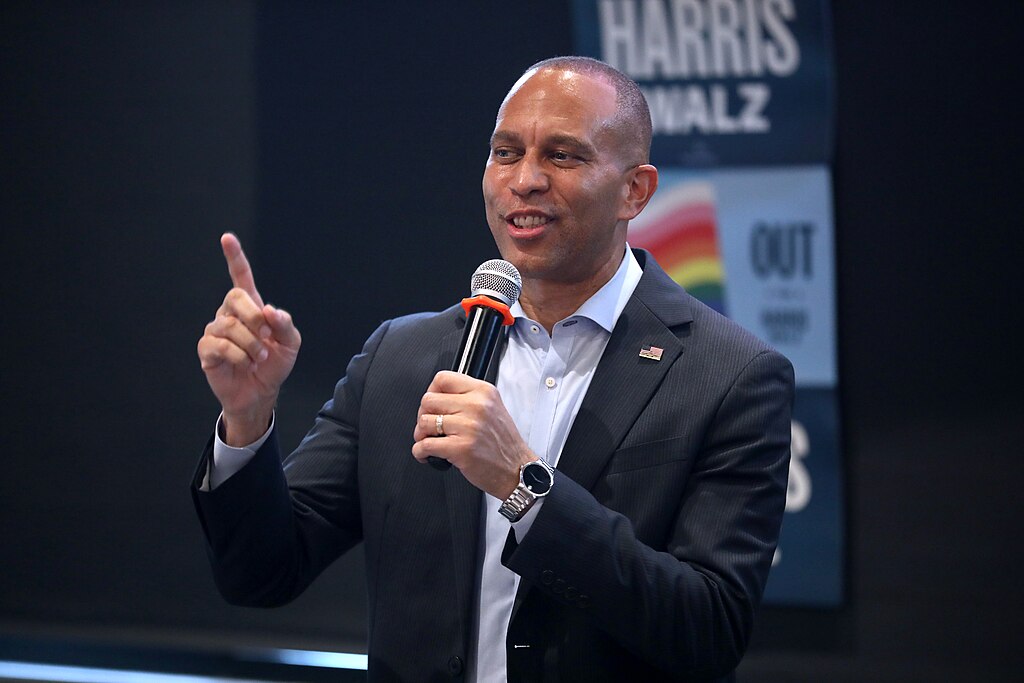
House Minority Leader Hakeem Jeffries (D-NY) turned warnings from top artificial intelligence figures into a Capitol Hill attack on Republican leaders, accusing them of leaving Washington without doing the work needed to confront the technology’s risks.
The New York Democrat told reporters Monday that the House should not begin its long pre-election break while AI safety questions remain unresolved.
Jeffries stopped short of naming a specific legislative fix, but argued that Congress should keep working “until something is done decisively to protect the safety and the well-being of the American people.”
“Republicans have completely abandoned their responsibility to legislate and engage in public policy efforts in a responsible fashion in the area of artificial intelligence,” Jeffries said.
His demand arrived after Dario Amodei, Elon Musk and Sam Altman each urged more caution from inside the AI industry over the weekend.
Amodei, who leads Anthropic, used a lengthy blog post to call for a slower climb toward stronger models, warning that the wrong pace could end in global catastrophe.
“We must slow the pace at which we improve the capabilities of AI models,” Amodei wrote. “Progress will still seem fast, and we must make wise use of the time we gain.”
His argument was not for freezing technical work. Amodei said companies needed enough room to align and safeguard models while outside reviewers tested them.
😷 Hold Anthony Fauci accountable for the Wuhan lab, the COVID cover-up, and the questions he refused to answer. 😷 Help Freedom Watch take the fight to federal court! ➡️➡️➡️ DONATE NOW!!! 🇺🇸🇺🇸🇺🇸
“Our pacing framework is an attempt to further strengthen our commitment to safety and encourage a race to the top,” Amodei wrote.
Musk, who originally co-founded OpenAI with Altman, amplified Amodei’s post on X with a brief agreement.
“Dario is right,” Musk wrote.
Altman made a similar case on X, writing that the public deserves confidence that American AI companies will handle more powerful systems responsibly.
“Every frontier lab must deliver on this, and there is no reason any of us should come to work if we cannot,” Altman wrote.
Altman did not call for the work to stop, but said the pace should be slower than what companies could otherwise manage.
“Pacing will be well worth this cost; no amount of American competitive pressure should justify recklessness, or let capabilities get ahead of alignment and monitoring,” Altman wrote.
The weekend alarm followed Jacob Coxon’s resignation from Anthropic. Coxon, a 27-year-old AI researcher, wrote on social media that researchers at major firms “believe AI could kill all humans” even as companies continue pursuing superintelligence.
Republican leaders, meanwhile, were not lining up behind Jeffries’ call for quick congressional action.
Speaker Mike Johnson (R-LA) warned Monday that rushing into new limits could load American tech companies with regulations and weaken the U.S. against foreign competitors.
“We cannot put a moratorium on this because China will overlap us, and that’s the challenge,” Johnson stated. “If Congress just races in and does some sort of emergency session to try to regulate AI, we will lose the race to China, and that is a threat to every single American.”
Johnson has arranged for the House to leave Thursday and remain away until after the Nov. 3 elections.
Senate Majority Leader John Thune (R-SD) also urged restraint in any AI bill, even while saying the most advanced models carry risks Congress can address.
“It needs to strike a balance, light touch. You don’t want to stifle innovation but you also want to make sure that the more advanced threats can be mitigated,” Thune told reporters.
Thune treated Coxon’s warning as the outer edge of the discussion, saying lawmakers should focus on a realistic approach that protects against dangerous models without undercutting the U.S. in its competition with China.
“There is a way in which Congress can put guardrails around those types of more consequential threats without in any way harming our ability to stay ahead in the AI race, which I also think is very important,” Thune said.
Jeffries pointed to the previous Congress as proof that a bipartisan AI framework had already existed.
He said the task force he launched with former Speaker Kevin McCarthy (R-CA) was built to protect public safety while keeping American AI companies successful.
That panel did not carry over into the new Congress, and Jeffries blamed President Trump’s return to the White House for ending it.
“Republicans in this Congress, at the direction of Donald Trump, detonated that bipartisan effort and endangered the health and the safety and the well-being of the American people in doing so,” Jeffries said.
Jeffries rejected the idea that Republicans were simply guarding against excessive regulation.
“They’re not really concerned about over-regulation. They want no regulation,” Jeffries said. “And that’s the height of irresponsibility.”
Senate Democratic Leader Chuck Schumer (D-NY) made his own push Monday, asking the Trump administration to brief every senator in a classified setting on AI risks.
“Warning bells are ringing louder than they ever have – and the Trump administration is looking the other way. Well, if they won’t hold themselves accountable, we will. And if Trump does not act, Congress must,” Schumer said in a statement.
Schumer’s requested briefing would cover frontier model testing, efforts to keep AI chips and semiconductor manufacturing equipment from moving to China, and the government’s strategy for defending against increasingly sophisticated AI-enabled cyberattacks.
Trump has defended data centers and argued against new AI limits, giving Democrats another line of attack as Election Day approaches.
On Truth Social, Trump wrote Monday that AI did not need a new regulatory framework so much as the right person in charge.
“The only control or ‘guardrails’ that AI needs is a STRONG AND SMART (High IQ!) PRESIDENT, and the U.S.A. has that, in spades!” Trump wrote. “The Trump Administration has stopped AI ‘people’ from doing bad, or potentially bad, ‘things.’”
Trump said his administration already holds criminal and regulatory authority over AI companies, then claimed that AI and data centers were being targeted by a conspiracy that benefited China.
“There is a SICK conspiracy going on against AI and Data Centers, and the only one that is happy about it is China,” Trump wrote.
He also wrote that the U.S. was ahead of China and would stay there.
“Conspiracy Theorists, Treasonists, Traitors, and Leakers, BEWARE!” Trump wrote.
Reporter: “There’s been so much concern about AI. Have you heard directly from any of these AI tech leaders? And you seem to downplay some of the concerns that we’ve heard.”
President Trump: “Yeah, yeah… No, I’m not downplaying, but it’s going to be more good than bad, but by… pic.twitter.com/S8LNIB4SBY
— RedWave Press (@RedWavePress) September 14, 2026
On Air Force One on Sunday, Trump disputed the suggestion that he was playing down AI dangers.
“I’m not downplaying,” Trump said. “But it’s going to be more good than bad, by a lot.”
Earlier Sunday in Ireland, Trump framed the debate around America’s race with China.
“Well, I’ll say this: We’re leading China in AI. We’re the most sophisticated country in the world, and frankly, I want to keep it that way because whoever wins AI wins,” Trump said.
He said some people warning about AI were raising fears over things that “won’t happen.”
“And we can put guardrails, we can do this and that, but, I think you have a lot of negative forces that are bringing it up that shouldn’t be bringing it up, and they’re bringing up things that won’t happen,” Trump said.