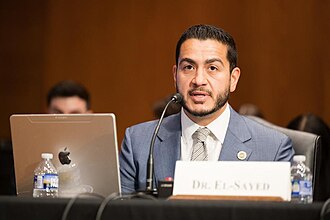
Michigan Democratic Senate hopeful Abdul El-Sayed faced questions about alleged family ties to the Muslim Brotherhood after his half-sister’s old social media posts appeared to conflict with his denials.
El-Sayed (D-MI) challenged NBC News journalist Tom Llamas over the relevance of the allegations, questioning why events involving his mother’s life in Egypt decades earlier were being raised during his Senate campaign.
President Donald Trump entered the controversy Wednesday with a separate accusation, alleging that El-Sayed personally belonged to the organization.
“Abdul, or as I call him Muhammad El-Sayad, he’s a member of the Muslim Brotherhood,” Trump declared. “You can’t have a member of the Muslim Brotherhood in Congress, being on one of our security committees.”
The allegation of personal membership has not been substantiated, and El-Sayed has rejected any connection to the group.
.@POTUS on Abdulrahman Mohamed El-Sayed: "He's a member of the Muslim Brotherhood. He said that years ago… You can't have a member of the Muslim Brotherhood in Congress." pic.twitter.com/8U933Gf1op
— Rapid Response 47 (@RapidResponse47) October 14, 2026
The Democrat defended his Michigan roots and professional record when Llamas questioned him about the family allegations.
“It’s funny to me. I was born in 1984, down the street in Rochester Hills,” El-Sayed responded. “I was raised here in Michigan, went to the University of Michigan, rebuilt the health department in the city, led the health department in this county. And you want to ask me about what was happening in Egypt in 1970? Are you serious?”
The questions concerned Eman Abdelhadi, a University of Chicago professor whose 2012 and 2013 social media posts were brought back into public view by the Washington Free Beacon. She and El-Sayed share a mother, Fatten Elkomy.
🎓Help millions think clearly and communicate with power through Hillsdale College’s free “Classical Logic and Rhetoric course! 🎓 Expand education for liberty and equip the next generation ➡️➡️➡️ TAKE THE FREE COURSE NOW!!! 🇺🇸🇺🇸🇺🇸
Abdelhadi’s accounts reached beyond a single relative. She wrote about political activity involving their mother and the consequences other family members had allegedly faced because of the Egyptian organization.
In July 2013, Abdelhadi expressed concern for relatives in Egypt amid consequences she associated with the movement.
“I have had family jailed for being a part of it,” she wrote, also advising relatives sympathetic to the Brotherhood in Egypt to “Lie low, stay safe.”
Her earlier remarks were more explicit about the family’s purported connection.
“My family has long been MB,” Abdelhadi wrote on June 24, 2012, using an abbreviation for the Muslim Brotherhood.
The Washington Free Beacon reported that Elkomy attended Alexandria University during the 1970s, when the organization maintained a presence there.
Abdelhadi also described an “amazing talk with my mom about her activism in the Muslim Brotherhood during the early 70s while she was in college.”
Those remarks establish what Abdelhadi publicly claimed about her relatives, not independent confirmation of their membership.
El-Sayed maintained that his childhood circumstances left him unfamiliar with his mother’s alleged political past, a distinction he considered important to the questions about his own connections.
“I’m telling you, like, I have no ties. We have no ties,” he insisted. “I have never had these conversations with my mother. I wasn’t raised by my mother.”
He dismissed the material presented by Llamas as “hearsay evidence from a tweet,” objecting to the implication that his earlier denials were dishonest.
El-Sayed had questioned Trump’s honesty in the past, a point Llamas raised while pressing the Democrat about the accuracy of his own answers.
“Do you think, are you insinuating that somehow I was lying?” the candidate demanded. “And I’m telling you I was not.”
El-Sayed had also denied the allegations on NBC’s “Meet the Press” Sunday. Moderator Kristen Welker first asked him to clarify the accusations involving his relatives, but received a one-word response.
“No,” El-Sayed replied.
Welker then sought confirmation that the denial covered both the candidate and his family. He repeated his answer and accused Republican Senate opponent Mike Rogers (R-MI) of making Islamophobic attacks against his family.
The campaign has portrayed the controversy as an effort by Rogers to steer the election away from economic concerns and Trump’s policies.
In remarks furnished to Fox News, a campaign spokesman described El-Sayed as “a dad and a doctor” and defended his work protecting the well-being of Michigan residents.
The spokesman characterized the allegations as “bad faith attacks on Abdul’s faith and family.”
Campaign representatives have also rejected the accusations as “debunked as racist and untrue,” without specifically explaining the historical statements attributed to Abdelhadi.
El-Sayed’s position on political developments in Egypt during 2012 has also attracted attention. His name appeared on an open letter endorsed by Egyptian-American leaders that urged the Muslim Brotherhood to “purge the media and police,” the Washington Free Beacon reported.
Around that period, he also publicly identified with supporters of Mohamed Morsi, who rose to Egypt’s presidency after the revolution as a Muslim Brotherhood leader.
Neither the letter nor his association with Morsi’s supporters establishes membership in the organization.
Established in Egypt in 1928, the Muslim Brotherhood eventually developed affiliated movements elsewhere in the region, including a Palestinian network from which Hamas emerged during the 1980s.
The Egyptian chapter has received a Specially Designated Global Terrorist designation. The Trump administration’s actions have addressed particular branches, while lawmakers have considered more extensive restrictions.
El-Sayed’s association with streamer Hasan Piker drew another challenge following his debate with Rogers last Thursday.
Piker had campaigned with the Democrat earlier this year, but El-Sayed rejected the idea that his association with the online personality should be judged by the same standards he applied to Trump.
He argued that a president’s authority to order military action made comparisons with “a streamer in California” inappropriate, dismissing the proposed equivalence as “silly.”
The reporter’s question had initially drawn a skeptical response from the candidate.
“That’s a serious question?” El-Sayed replied.
He then pointed to the enormous responsibilities that distinguish the presidency from an internet commentator’s platform.
“Well, Donald Trump is the president of the United States, which means he has significant power, including holding the nuclear football,” El-Sayed explained.