

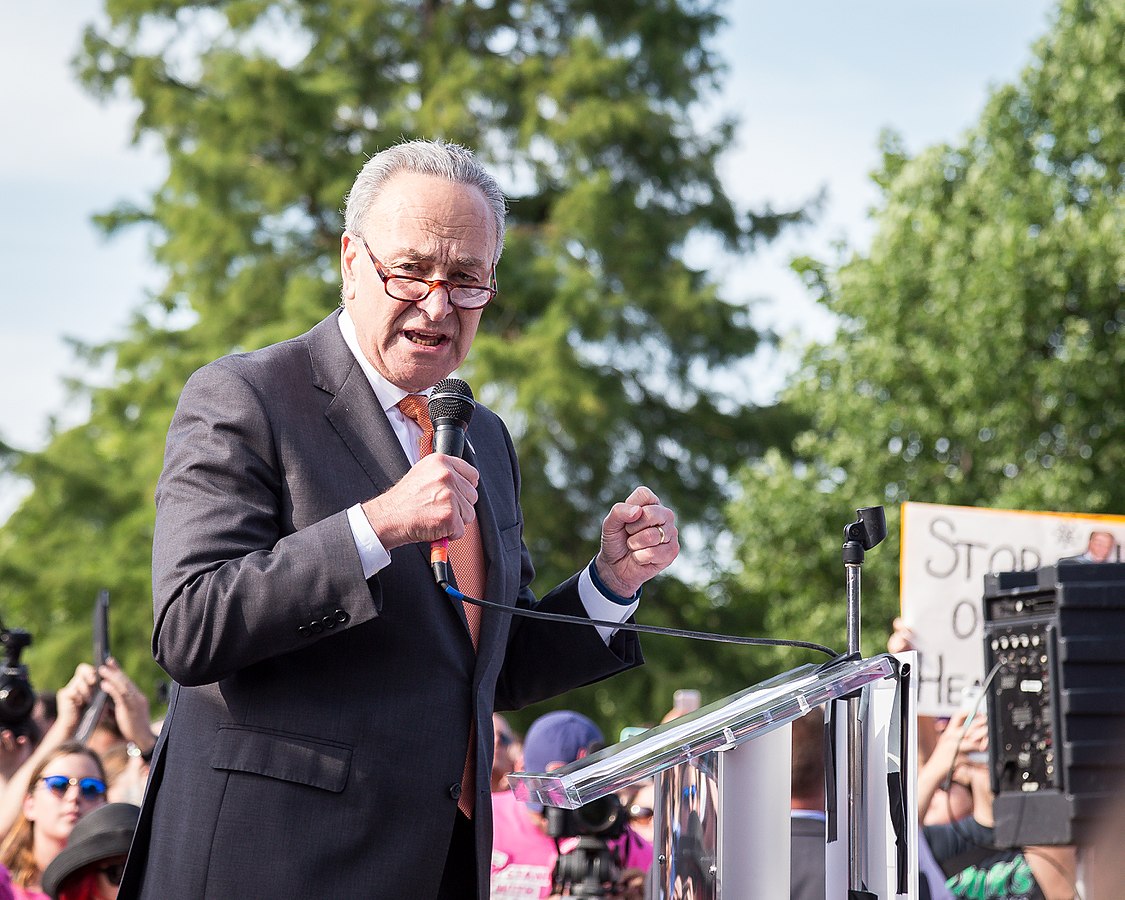
Senator Chuck Schumer lashed out after Senate Republicans passed a $70 billion border-and-deportation funding package.
He accused the GOP of giving President Donald Trump more money, more power and a taxpayer-backed enforcement machine while doing nothing to ease costs for American families.
The Senate passed the measure 52-47, with Alaska Republican Lisa Murkowski breaking ranks and joining Democrats against it.
The package would bankroll Immigration and Customs Enforcement and Customs and Border Protection operations for the next three and a half years, giving Trump the resources to expand the mass-deportation agenda he has made central to his second term.
Schumer responded by accusing Republicans of choosing Trump’s priorities over voters’ wallets.
In a statement after the vote, the New York Democrat called the bill “rotten” and said it exposed the GOP’s governing agenda as “more money for Donald Trump, more power for Donald Trump, and nothing to lower costs for working families.”
He also blasted Republicans for refusing to permanently kill a proposed anti-weaponization fund that Democrats have repeatedly labeled a Trump “slush fund.”
Schumer said the vote left taxpayers relying on “nothing more than a promise from Donald Trump’s personal fixer,” calling that “not accountability” but “a permission slip.”
🎓Learn how Marxist ideas shaped modern culture and how to challenge them with Hillsdale College’s free course! 🎓 Explore the history and impact of Marxism in America ➡️➡️➡️ TAKE THE FREE COURSE NOW!!! 🇺🇸🇺🇸🇺🇸
The fund was created through a settlement agreement in Trump’s lawsuit against the IRS over the disclosure of his tax returns.
The Justice Department said last month that Attorney General officials had established “The Anti-Weaponization Fund” to create a process for people who claimed they were harmed by government weaponization or lawfare.
The DOJ said the fund would receive $1.776 billion from the judgment fund, a standing federal appropriation used to settle and pay claims.
Democrats had pushed to use the border-funding bill to outlaw the fund permanently.
Republicans pointed to recent testimony from acting Attorney General Todd Blanche, who told Congress the administration was not moving forward with it.
Senate Majority Leader John Thune argued the issue had effectively been resolved, but Democrats were not satisfied with verbal assurances.
Schumer released another statement after the vote, accusing Republicans of protecting “Donald Trump’s $2 billion slush fund” instead of helping working Americans.
He also said Democrats forced Republicans to vote on amendments dealing with housing, gas prices, health insurance and childcare, only to watch GOP senators reject them.
Thune accused Democrats of walking away from negotiations for political reasons.
“Democrats would not agree to anything, and eventually they walked away altogether, presumably because they thought that it would serve them better to have an issue for November,” Thune said.
The package still must pass the House before it can reach Trump’s desk.
The border-funding fight was not the only late-night clash on Capitol Hill.
Early Friday, Senate Democrats blocked an effort to begin debate on extending enhanced surveillance authorities under Section 702 of the Foreign Intelligence Surveillance Act, which are set to expire June 12.
Every Senate Democrat except Pennsylvania Sen. John Fetterman voted against moving to the House-passed measure that would have served as the vehicle for renewing the powers.
Six Republicans also voted no: Josh Hawley, Mike Lee, Rand Paul, Eric Schmitt, Rick Scott and Tommy Tuberville.
The motion failed 47-52, throwing the renewal effort into uncertainty just days before the deadline.
Democrats used the vote to protest Trump’s decision to install Bill Pulte as acting director of national intelligence.
Senate Intelligence Committee Chairman Tom Cotton had been close to a bipartisan deal with Sen. Mark Warner, the panel’s Democratic vice chairman, before the talks collapsed.
Warner said Democrats could not extend surveillance powers while Pulte was positioned to oversee sensitive intelligence.
“The bipartisan bill that Tom Cotton and I worked on was a good bill, but the idea that a few days before critical moments on FISA renewal that the president picked someone so grossly unqualified, you just can’t abide that,” Warner commented after the measure failed.
Warner said he understood the importance of Section 702 but argued Pulte did not meet the qualifications needed for the intelligence role.
“Nobody needs to tell me how important 702 is, but I also know that someone who doesn’t even meet the basic qualifications of the law to be director of national intelligence shouldn’t be put in that position, particularly when he’s got a history of taking and weaponizing confidential information,” he criticized.
Warner added that Democrats would provide “more than enough” votes for renewal if Pulte were removed from the acting intelligence post.
Pulte has drawn Democratic fury for using mortgage records to support criminal referrals and investigations involving Trump critics, including Federal Reserve board member Lisa Cook, New York Attorney General Letitia James and Sen. Adam Schiff.
Thune called the Democratic blockade reckless and said Republicans would try again next week to extend the surveillance authority before it expires.
“We’ll take another run at it. We’re going to need some help from Democrats, obviously. I think it’s a terribly irresponsible position that they’ve taken, but we’ll find out if that changes,” he noted.
The South Dakota Republican rejected Democratic claims that Pulte could use intelligence powers against Trump’s enemies.
“I don’t know how he would weaponize intelligence, but I find it hard to believe that that would be something he would do in that position,” Thune added.
Trump, meanwhile, told The Wall Street Journal that he wants Pulte to shrink the Office of the Director of National Intelligence.
“I’d like to see it smaller. I think there are a lot of people in there that shouldn’t be there,” Trump commented during an interview.
The president said Pulte would not hold the role permanently, suggesting he does not plan to nominate him for Senate confirmation.
But Trump argued that acting status could give Pulte more flexibility.
“You’re less shackled,” he added “It sort of gives you more power, you know, for a somewhat limited period of time.”
Trump also said Pulte could carry out the hard work of cutting the office before a permanent nominee arrives.
“Frankly, it might be good for him to shake it up before people come,” the President continued.
“Because, if he reduced the size, in conjunction with me … and in conjunction with possibly the person coming in … he can do a lot of the hard work and we wouldn’t have to saddle somebody that goes in.”
Trump said he also wants Pulte to review classified material tied to the 2020 election.
“I would say everything — he should look at everything and make a determination,” Trump said.






Schumer knows to make senators vote on it to put them on record. Thune hasn’t figured that out on the Save America Act.
Shumucky is the snake oil salesman. We want the illegals deported and would prefer the money went to removing them than into the pockets of slimes like Shumucky and that means Schumer who is a smuck!
How long will the ignorant continue to vote for Democrats who openly advocate destroying this country?