
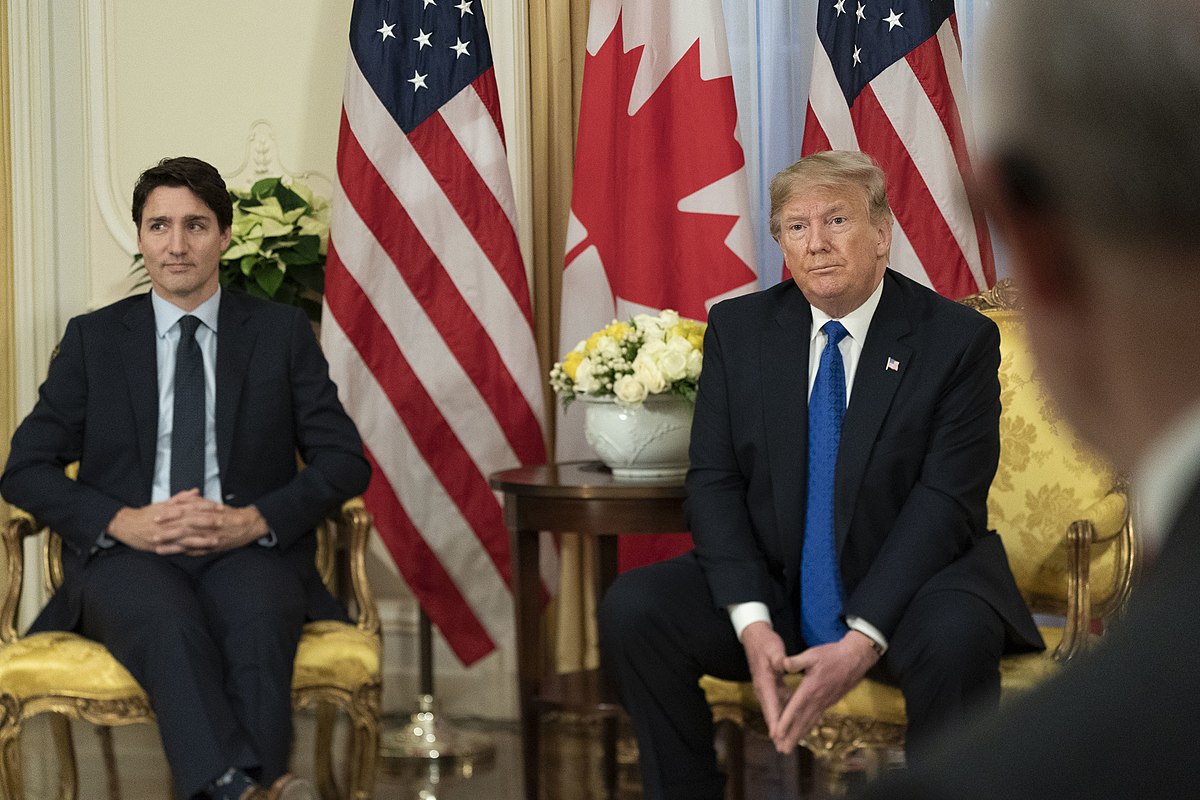
President Donald Trump announced Thursday that Canada is no longer invited to join his newly established Board of Peace, reversing an earlier outreach to the Canadian government.
In a statement posted on Truth Social, Trump said the invitation had been withdrawn and addressed the decision directly to Canadian Prime Minister Mark Carney.
“Dear Prime Minister Carney: Please let this Letter serve to represent that the Board of Peace is withdrawing its invitation to you regarding Canada’s joining, what will be, the most prestigious Board of Leaders ever assembled, at any time,” Trump wrote.
🚨 JUST IN: President Trump has just REVOKED the invite he extended Canadian PM Mark Carney to join the Board of Peace
This comes after Carney tried to play tough and SH*T TALKED President Trump at the World Economic Forum
Remember Carney: Canada would NOT exist without the US! pic.twitter.com/CPvyYx2P2I
— Nick Sortor (@nicksortor) January 23, 2026
Earlier Thursday, Canadian officials had indicated that Ottawa had accepted an invitation to participate in the board.
Carney told reporters last week that Canada had agreed “in principle” to join, while noting that key details remained unresolved, including how the body would operate and how reconstruction efforts in Gaza would be funded.
Carney also said that unimpeded humanitarian aid to Gaza would be a precondition for moving forward.
🚨 JUST IN: What just happened in Davos was WILD…
Right after the Board of Peace was signed, President Trump walked down the line and met with world leaders one-by-one — and you could literally feel the energy in the room.
They weren’t just “greeting” him…
They looked… pic.twitter.com/nh4mZ2jynv
— Charlie’s Voice Rising (@CharlieK_news) January 22, 2026
Members of Carney’s government also said Canada would not contribute financially in exchange for membership.
Industry Minister François-Philippe Champagne told reporters earlier this week that “Canada is not going to pay if we were to join the Board of Peace.”
Trump formally unveiled the Board of Peace during a speech and signing ceremony Thursday at the World Economic Forum in Davos, Switzerland.
Leaders from Latin America, Europe, the Middle East, and Central and Southeast Asia joined him on stage.
Trump described the board as potentially “one of the most consequential bodies ever created” and said it would be an “enormous honor” to serve as its chairman.
He said the board would work alongside the United Nations, which he said has “tremendous potential,” adding that the two organizations together could offer something “very, very unique for the world.”
Secretary of State Marco Rubio, who also addressed the event, thanked the leaders who attended and said additional countries were expected to join.
“Others will join,” Rubio said. “Many want to be a part of this effort, because it is going to be a successful effort.”
Rubio said the board would take concrete action rather than rely on statements alone.
“We often find ourselves at events where people are reading these scripted statements, these strongly worded letters that they put out, but no action. Nothing happens,” Rubio said.
The decision to rescind Canada’s invitation followed comments Trump made Wednesday regarding Greenland and U.S. missile defense.
Speaking at the forum in Davos, Trump said the United States should control Greenland in order to construct a large-scale “Golden Dome” missile defense system, which he said would also protect Canada.
“We’re building a Golden Dome that’s going to, just by its very nature, be defending Canada,” Trump said.
Trump to Carney: "Canada lives because of us. Mark, remember that before you make those speeches." pic.twitter.com/ZwlTdSdSgN
— End Wokeness (@EndWokeness) January 21, 2026
“Canada gets a lot of freebies from us, by the way. They should be grateful also.”
Trump said he was dissatisfied with recent remarks by Carney and suggested Canada benefits from U.S. security support.
“They should be grateful to us, Canada. Canada lives because of the United States,” Trump added. “Remember that, Mark, the next time you make your statements.”
Carney responded Thursday, rejecting Trump’s characterization.
“Canada doesn’t live because of the United States. Canada thrives because we are Canadian,” Carney stated.
Trump: “Canada lives because of the U.S.”
Mark Carney: “Canada doesn’t live because of the U.S. Canada thrives because we are Canadian.”
Trump talks about allies like they’re pets on a leash.
Carney just reminded him that Canada isn’t owned. pic.twitter.com/VcX0Eenpgc
— Brian Allen (@allenanalysis) January 22, 2026
In remarks that did not mention Trump by name, Carney warned that the rules-based international order is weakening as major powers increasingly use economic and security leverage to pressure allies.
During a speech earlier this week at the World Economic Forum, Carney spoke of what he described as a “rupture in the world order,” comments that appeared to reference growing geopolitical tensions, including disputes involving Greenland.
“If great powers abandon even the pretense of rules and values for the unhindered pursuit of their power and interests, the gains from transactionalism will become harder to replicate,” Carney told the forum.
He argued that so-called middle powers, including Canada, must respond by diversifying partnerships, strengthening collective action, and emphasizing respect for national sovereignty.
According to the White House, Trump will chair the Board of Peace, which is expected to include senior political, diplomatic, and business figures.
Participants named by the administration include Trump’s son-in-law Jared Kushner, Rubio, U.S. Special Envoy Steve Witkoff, and billionaire Marc Rowan.
The administration has extended invitations to a range of countries, including Russia, Belarus, France, Germany, Vietnam, Finland, Ukraine, Ireland, Greece, Israel, and China.
Russia and China have confirmed receiving invitations but have not said whether they will participate.
The United Kingdom, France, Norway, Sweden, and Slovenia have indicated they would not immediately join.
French President Emmanuel Macron’s office said the board’s charter raises questions about its relationship to the United Nations.
The statement said the charter “goes beyond the sole framework of Gaza and raises serious questions, in particular with respect to the principles and structure of the United Nations, which cannot be called into question.”
More than 20 countries have said they plan to join the board, including Albania, Argentina, Armenia, Azerbaijan, Bahrain, Belarus, Bulgaria, Egypt, Hungary, Indonesia, Israel, Jordan, Kazakhstan, Kosovo, Mongolia, Morocco, Pakistan, Paraguay, Qatar, Saudi Arabia, Turkey, the United Arab Emirates, Uzbekistan, and Vietnam.
This morning, President Trump unveiled his historic Board of Peace.
The leaders of the world are now in a position to enact incredible change for the Middle East. All of this was possible only because of the vision and the drive of the President of the United States. pic.twitter.com/KCUm8BE8CZ
— Department of State (@StateDept) January 23, 2026
In November, the U.N. Security Council approved the creation of a Board of Peace as part of a broader proposal that included establishing a security force in Gaza.
The current charter for Trump’s board outlines a broad mandate for a new international organization intended to promote stability, governance, and peace in areas affected by conflict.
The charter states that Trump will serve as chairman and may be replaced only through voluntary resignation or incapacity, as determined by a unanimous vote of the executive board.
It also provides that member states generally serve terms of no more than three years, with exceptions for countries that contribute more than $1 billion.
The White House Rapid Response account said the $1 billion figure does not represent a minimum membership fee.
This is misleading. There is no minimum membership fee to join the Board of Peace.
This simply offers permanent membership to partner countries who demonstrate deep commitment to peace, security, and prosperity. https://t.co/c4bVUBfnW8
— Rapid Response 47 (@RapidResponse47) January 18, 2026
The account said the contribution threshold offers permanent membership to countries demonstrating a long-term commitment to peace, security, and prosperity.
After the signing ceremony, Trump met with Ukrainian President Volodymyr Zelenskyy.
Zelenskyy said representatives from Ukraine, Russia, and the United States are expected to meet in the United Arab Emirates this week, marking what he described as the first such meeting involving all three parties since the start of the Russia-Ukraine conflict.
Separately, the Kremlin said Russian President Vladimir Putin discussed the possibility of donating $1 billion to the Board of Peace during conversations with Witkoff and Kushner.
BREAKING 🚨 President Putin says Russia is ready to contribute $1 billion to President Trump's "Board of Peace” and accepts Trump’s offer to join
Trump is the PEACE President of the world
PEACE THROUGH STRENGTH 🔥 pic.twitter.com/r31yBcQJnj
— MAGA Voice (@MAGAVoice) January 21, 2026
Kremlin foreign policy aide Yury Ushakov said Russia’s willingness to direct funds from frozen Russian assets would be contingent on the United States unfreezing some of those assets.
“During the exchange of views on the Peace Council, our readiness to direct one billion dollars to this organization’s budget from Russian assets frozen by the previous U.S. administration was emphasized,” Ushakov told reporters.
Rename Board of Peace:
Free Nations Alliance
Western Nations Board