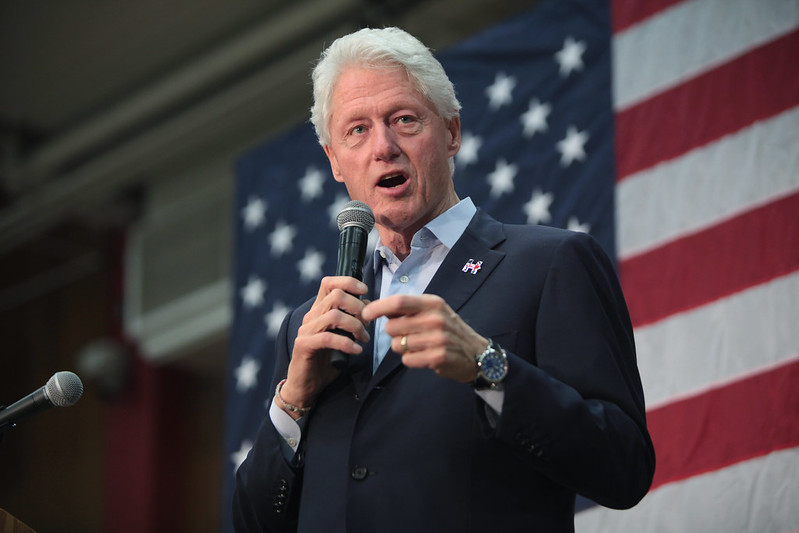
The House Oversight Committee voted to recommend holding former President Bill Clinton and former Secretary of State Hillary Clinton in contempt of Congress for failing to comply with subpoenas issued as part of its investigation into Jeffrey Epstein.
The recommendations followed a lengthy markup hearing and now move to the full House of Representatives for consideration.
Republicans hold a majority in the chamber, making approval of the contempt resolutions likely.
If the House adopts the recommendations, the Justice Department would then decide whether to pursue enforcement actions.
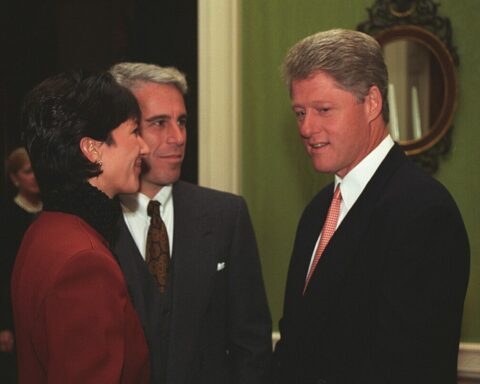
🚨 BREAKING: New photo of Bill Clinton swimming with Ghislaine Maxwell and a potential victim and/or minor
Per the Epstein Files Transparency Act, DOJ was specifically instructed only to redact the faces of victims and/or minors
This is pretty damning for Bill Clinton. pic.twitter.com/ShXkEv0Bfm
— Nick Sortor (@nicksortor) December 19, 2025
Committee leaders said the subpoenas were bipartisan and lawful and accused the Clintons of willfully defying them.
The subpoenas were issued after photos surfaced showing Bill Clinton on Epstein’s private island, according to committee members.
In a letter dated Jan. 13 and addressed to Oversight Committee Chairman James Comer, attorneys for the Clintons said they believed the subpoenas were “legally invalid.”
The letter said the former president and former secretary of state had attempted to provide the committee with the limited information they said they possessed.
“We’ve done so because Mr. Epstein’s crimes were horrific,” the letter stated, adding that there was “no plausible explanation” for the committee’s actions “other than partisan politics.”
The committee’s action comes amid continued debate over the release of records related to Epstein.
Congress passed the Epstein Files Transparency Act in November by near-unanimous margins in both chambers, and President Donald Trump later signed the bill into law.
Some Democrats have argued that the Justice Department has been too slow in making the files public.
During Wednesday’s hearing, lawmakers debated what Comer described as “acceptable terms” for compliance with the subpoenas, including whether depositions should be recorded and whether additional members of Congress could participate.
Comer said negotiations with the Clintons’ attorneys had been ongoing for several months.
He said the committee expected testimony from Bill Clinton and argued that former presidents are not exempt from congressional oversight.
“They have had five months to comply with this,” Comer said during the hearing.
Before the markup, Comer wrote on social media that the Clintons’ lawyers proposed a private meeting in New York with Bill Clinton that would not include a formal transcript and would bar other members of Congress from attending. Comer said he rejected the proposal.
“The Clintons’ latest demands make clear they believe their last name entitles them to special treatment,” Comer wrote.
Democratic members of the committee objected to the contempt recommendations, arguing that the effort amounted to political targeting and that similar standards were not being applied to other witnesses.
Rep. Yassamin Ansari of Arizona said Attorney General Pam Bondi had not complied with a subpoena issued by the committee and argued that fairness required equal enforcement.
“If you want to be fair and care about justice for the victims here … we should be holding her in contempt,” Ansari said during the hearing.
Comer responded that Bondi had turned over documents and noted that she is expected to testify before the House Judiciary Committee next month, where she could be questioned about the Epstein files process.
Rep. Summer Lee of Pennsylvania introduced an amendment to hold Bondi in civil contempt.
Lee said she supported accountability but argued that the contempt effort against the Clintons was being fast-tracked.
Rep. Dave Min of California suggested pursuing civil enforcement of the subpoenas instead of criminal contempt.
CA Dem Rep Dave Min defends the Clintons during contempt hearing; says that “bringing criminal charges against a former president” would be a very serious matter.
Right, Congressman. Doing something like that would be unheard of and totally crazy. pic.twitter.com/NLpNS6PCPV
— Western Lensman (@WesternLensman) January 21, 2026
Comer rejected the proposals, citing guidance from committee counsel. The Democratic amendments failed to pass.
The committee approved a contempt recommendation against Bill Clinton by a vote of 34–8, with two members voting present. Nine Democrats joined Republicans in supporting the measure.
In a separate vote, the committee approved a contempt recommendation against Hillary Clinton by a vote of 28–15, with one member voting present. Three Democrats voted in favor of that resolution.
Following the votes, Comer said the committee’s actions were intended to uphold Congress’ investigative authority.
“By voting to hold the Clintons in contempt, the Committee sent a clear message: no one is above the law,” Comer wrote in a post on X, describing the subpoenas as bipartisan and lawfully issued.
🚨Republicans and Democrats on the House Oversight Committee acted today to hold former President Bill Clinton and former Secretary of State Hillary Clinton in contempt of Congress for willfully defying lawful and bipartisan subpoenas.
By voting to hold the Clintons in…
— Rep. James Comer (@RepJamesComer) January 21, 2026
The committee’s investigation also includes testimony from other figures connected to Epstein.
Ghislaine Maxwell, a longtime associate of Epstein, has agreed to appear before the committee in February, according to Comer.
Maxwell is scheduled to testify virtually on Feb. 9, an Oversight Committee spokesperson said.
Maxwell is serving a 20-year federal prison sentence after being convicted in 2021 of recruiting and trafficking underage girls for Epstein.
Comer said Maxwell’s attorneys have indicated she plans to invoke her Fifth Amendment right against self-incrimination.
“I hope she changes her mind, because I want to hear from her,” Comer said in an interview.
In a letter submitted to the committee, Maxwell’s lawyers said proceeding with the deposition would amount to political theater and would not produce testimony or new information.
Separately, a federal judge ruled Wednesday that he lacks jurisdiction to appoint an outside expert to oversee the Justice Department’s compliance with the Epstein Files Transparency Act.
U.S. District Judge Paul Engelmayer denied a request by Reps. Ro Khanna of California and Thomas Massie of Kentucky to participate in the Maxwell case as amici curiae.
The lawmakers had asked the court to appoint a special master to oversee the release of Epstein-related records.
Engelmayer said the lawmakers were not parties to the criminal case and that the court therefore could not grant their request.
Khanna said the lawmakers would continue to pursue other legal avenues to ensure the release of the files.
He said the judge acknowledged concerns about whether the Justice Department is complying with the law and said lawmakers would continue pressing for transparency.
Watch the entire markup here: