

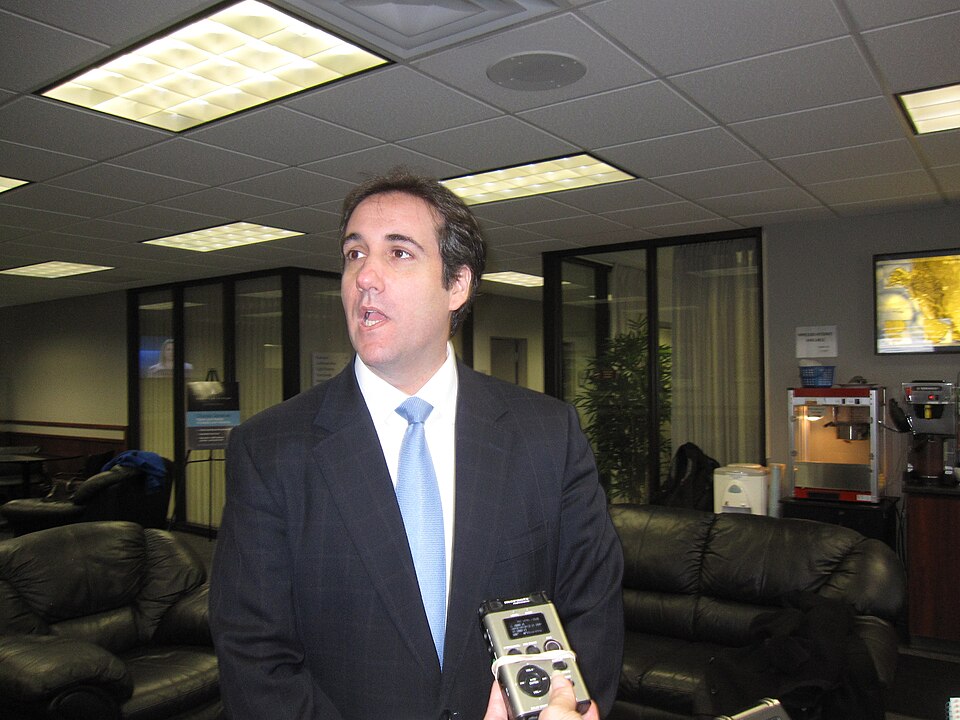
Former Trump lawyer Michael Cohen accused New York prosecutors Friday of leaning on him to deliver testimony aimed squarely at convicting President Donald Trump.
Cohen claimed lawyers from the Manhattan District Attorney’s Office and the New York Attorney General’s Office boxed him in from the start, steering him toward answers they believed would help land judgments and convictions against Trump.
He described a pressure campaign that he says followed him from early meetings through courtroom testimony, insisting prosecutors showed little interest in information that did not support their case theory.
“From the time I first began meeting with lawyers from the Manhattan DA’s Office and the New York Attorney General’s Office in connection with their investigations of President Trump, and through the trials themselves, I felt pressured and coerced to only provide information and testimony that would satisfy the government’s desire to build the cases against and secure a judgement and convictions against President Trump,” Cohen wrote.
BREAKING 🚨 Donald Trump said Michael Cohen said he was ‘COERCED’ by Letitia James and Alvin Bragg
THIS IS ABSOLUTELY WILD pic.twitter.com/HYMoOyBhAV
— MAGA Voice (@MAGAVoice) January 17, 2026
The allegation surfaced in a Substack post where Cohen also noted that a federal appeals court revived Trump’s bid to undo his conviction tied to business records.
Cohen framed the development as proof that legal questions surrounding the case are far from settled, even as the underlying verdict remains intact.
His claims target two high-profile New York prosecutions that placed Cohen at the center of efforts to take down Trump.
Cohen testified in a civil fraud case brought by Attorney General Letitia James in 2023, a proceeding that ended with Trump found liable for inflating asset values to secure favorable loans.
He later took the stand in Manhattan District Attorney Alvin Bragg’s criminal case in 2024, where prosecutors accused Trump of falsifying business records.
During that trial, Cohen told jurors he worked with former Trump Organization CFO Allen Weisselberg to reverse engineer financial figures to hit Trump’s desired totals.
Trump repeatedly attacked Cohen’s credibility at the time, portraying him as an unreliable witness with a criminal past.
VENEZUELAN DICTATOR NICOLAS MADURO CAPTURED, IN U.S. CUSTODY
President Trump delivered a historic win for freedom, proving our military is SECOND TO NONE and the world still fears American resolve.….
Do you AGREE Trump made America STRONG again?
Take the Freedom Poll NOW and stand with President Trump!!!
“The witness is already totally discredited,” Trump told reporters outside court, adding that prosecutors “used somebody who is a felon.”
“You all know his record. It’s a horrible one,” Trump said of Cohen. “All you have to do is ask the Southern District of New York.”
Despite those attacks, a Manhattan jury in May 2024 convicted Trump on 34 counts of falsifying business records in the first degree over payments routed through Cohen to adult actress Stormy Daniels during the 2016 campaign.
Trump responded to Cohen’s latest accusations by blasting both New York cases as politically rigged.
“These horrible Radical Left people, doing everything possible to destroy our Country, should pay a big price for this!” Trump wrote on Truth Social, calling the prosecutions a “SET UP from the beginning.”
“New York Courts, with many fair and wonderful Judges, are embarrassed by what has happened! We cannot let this pass,” he added.
Cohen’s Substack post asserted that an appeals court ordered a lower court to reexamine whether Trump’s business records case belongs in state court or should be shifted to federal jurisdiction.
Cohen argued his account carries weight because it is rooted in personal experience rather than abstract legal debate.
“My perspective is not theoretical,” he wrote, calling it “lived” after testifying in two trials targeting Trump.
He walked readers through the first case, describing the civil action by James’ office alleging Trump inflated asset values.
“The court found President Trump liable and ordered that he and other defendants pay a staggering $454 million penalty, which was later overturned on appeal,” Cohen wrote.
He then detailed the second case, a criminal prosecution brought by Bragg accusing Trump of falsifying business records tied to hush money payments.
Cohen said his earliest contact with Manhattan prosecutors came in August 2019 while he was serving a three-year prison sentence for federal crimes.
He recalled asking prosecutors almost immediately how cooperation could benefit him, citing his desire to secure a Rule 35(b) motion, return home, and rebuild his life.
Cohen claimed that dynamic set the tone for everything that followed.
He alleged that prosecutors signaled repeatedly that only testimony advancing a conviction would be useful.
“It was clear” they were focused solely on evidence that “would enable them to convict President Trump,” Cohen wrote.
He accused prosecutors of crossing lines in court when his answers failed to match their preferred narrative.
“When my testimony was insufficient for a point the prosecution sought to make, prosecutors frequently asked inappropriate leading questions to elicit answers that supported their narrative,” Cohen wrote.
Cohen also addressed recent appeals-level debate surrounding the cases, noting it has not cleared Trump of guilt or liability.
Instead, he argued the scrutiny has exposed how what he described as a rush for convictions can lead to witnesses being leaned on.
Cohen said his decision to speak publicly now was driven by concern about long-term damage to the justice system.
“You may reasonably ask why I am speaking out now,” he wrote. “The answer is simple. I have witnessed firsthand the damage done when prosecutors pick their target first and then seek evidence to fit a predetermined narrative.”
“Justice must be more than effective; it must be credible,” Cohen continued. “When politics and prosecution become indistinguishable, public trust erodes.”
Cohen’s own legal history remains part of the backdrop to his claims.
In December 2018, he was sentenced to three years in prison for making hush money payments and lying to Congress about past business dealings in Russia.
A federal judge ordered Cohen released to home confinement in July 2020, ending his incarceration but not the controversy surrounding his role in Trump’s legal saga.
Michael Cohen is what is commonly called a “SHEISTER LAWYER”. Trump should have known that from the beginning. That being said I don’t think anybody not a demonRAT is surprised by his claim. After NY’s handling of Jeffrey Epstein held in the most secure facility was able to be killed by the NYC law enforcement / justice system, how can anything concerning NY be believed ??? Hopefully Maduro will not be murdered like Epstein !!!
How is this a bombshell. It was widely known at the time.
Same Deep Swamp system at work here
Marsupial justice.
What does it all imply. The whole thing was rigged from the beginning by a bunch of corrupt New York prosecutors, to discredit Trump and have him convicted of boges crimes.