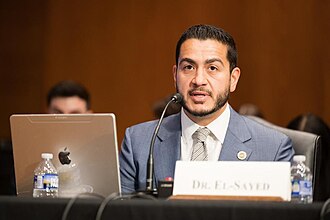
Donald Trump says he will meet with Abdul El-Sayed after the Michigan Democrat pitched universal healthcare with a gold card bearing the president’s name.
Trump praised the senator-elect’s promotional approach in a Tuesday interview with the New York Post, but offered neither a meeting date nor an agreement on policy. El-Sayed, the former Detroit health chief, became America’s first Muslim senator-elect in this month’s election.
“He’s a smart guy,” Trump said. “He did a good job.”
“I know I’ll be meeting with him,” the president added, suggesting they might find common ground.
El-Sayed’s campaign for Trump’s attention included November 12 mock-ups posted on X of a gilded “TrumpCare” card resembling the president’s Gold Card visa for wealthy foreigners. It carried Trump’s signature and promised no premiums, deductibles or copays for covered services.
This is a message for @realDonaldTrump.
Donald, this is on the table. Guarantee healthcare for every American, from cradle to grave. pic.twitter.com/f32IYs3FXG
— Dr. Abdul El-Sayed (@AbdulElSayed) November 12, 2026
“Donald, this is on the table. Guarantee healthcare for every American, from cradle to grave,” El-Sayed wrote on X.
El-Sayed told NPR that securing passage mattered more to him than the name attached to the program.
“Put his name on it,” he said. “He’ll probably pass it.”
🎇Honor America’s 250th Anniversary!!!🎇 Get your 2026 Heritage Foundation commemorative membership card ➡️➡️➡️ ACTIVATE YOUR MEMBERSHIP NOW!!! 🇺🇸🇺🇸🇺🇸
In a November 17 video, he addressed the president as “habibi,” an Arabic expression of affection, and acknowledged the difficult midterm results.
Trump shared the pitch on Truth Social last weekend. “Let’s get to work, then. Ready when you are,” El-Sayed responded.
On NBC’s “Meet the Press” Sunday, El-Sayed told Kristen Welker that securing coverage mattered more than the program’s title. He recalled campaigning on reducing money’s influence in politics, improving voters’ finances and Medicare for All.
“Now, I don’t really care what it’s called. I care that the people of this country finally have the unmet promise of guaranteed healthcare in this country,” El-Sayed said.
He said he was open to discussions, as was Maryland Sen. Chris Van Hollen, who is seeking to lead Senate Democrats in January. El-Sayed said guaranteed healthcare could secure the lasting legacy Trump wanted, calling his proposal the ultimate Trump card.
In a Saturday statement, El-Sayed also named Bernie Sanders, Ron Wyden and Elizabeth Warren as potential partners in delivering guaranteed coverage.
“If the President is serious about meeting the unmet promise of guaranteed healthcare in this country, I’m ready to work alongside leaders in the Senate like Senators Van Hollen, Sanders, Wyden, and Warren to deliver,” El-Sayed said. “President Trump, give me a call.”
Sanders told The Associated Press last Wednesday that he intended to pursue Medicare for All as the expected next chairman of the Senate Health, Education, Labor and Pensions Committee. He described universal coverage as no longer a utopian idea.
The proposal would establish a universal system over four years. In its first year, it would lower Medicare eligibility from 65 to 55, add dental and vision benefits and guarantee care for children through age 18, according to the AP.
El-Sayed backed Sanders’s approach in his Welker interview, comparing access to healthcare with the entitlement to public schooling. Van Hollen, appearing later on the program, described changes Sanders was considering and emphasized opportunities for earlier progress.
Van Hollen said lawmakers were examining Medicare buy-in access for people ages 55 to 65, coverage for children and broader Medicare benefits. He characterized those measures as significant steps that could be taken in the early stages.
“So, we also need to expand coverage under Medicare. So, there are lots of things we can do, and I mean big things, in the early stages,” Van Hollen said.
El-Sayed also endorsed a narrower Democratic expansion proposal Tuesday, while maintaining that it should not replace the ultimate goal of universal access. Speaking to MS NOW’s Jen Psaki, he called it a great start.
“I think the challenge we sometimes have is we realize that if we want to climb Mount Everest, none of us are supermen, so we can’t leap it in one tall bound,” El-Sayed said.
“If that’s the base camp we need to get to, great, but understanding that it’s still not enough,” El-Sayed said. “We will not have achieved the unmet promise in this country of health care that you can depend on from cradle to grave until we finally guarantee it to everybody.”
House Minority Leader Hakeem Jeffries has endorsed reducing Medicare’s eligibility age, expanding benefits and extending coverage to children. Those proposals fall short of the comprehensive government-funded system El-Sayed made central to his campaign.
Democratic leaders also face demands from members seeking broader changes as the party prepares to control both chambers following its midterm victories.
Massachusetts Rep. Ayanna Pressley’s proposed legislative agenda, announced Tuesday, included Medicare for All, abolishing Immigration and Customs Enforcement and advancing reparations for Black Americans.
Trump’s comments about healthcare cooperation came alongside a confrontational opening strategy for dealing with the incoming Democratic majorities. He told the Post that he intended to use vetoes until lawmakers became willing to negotiate.
When asked about working with Democrats, Trump said he was “going to veto everything there is, and then at some point I think they’re going to want to negotiate.”
“I will, and we can do healthcare. We can do a lot of great things together,” he continued.