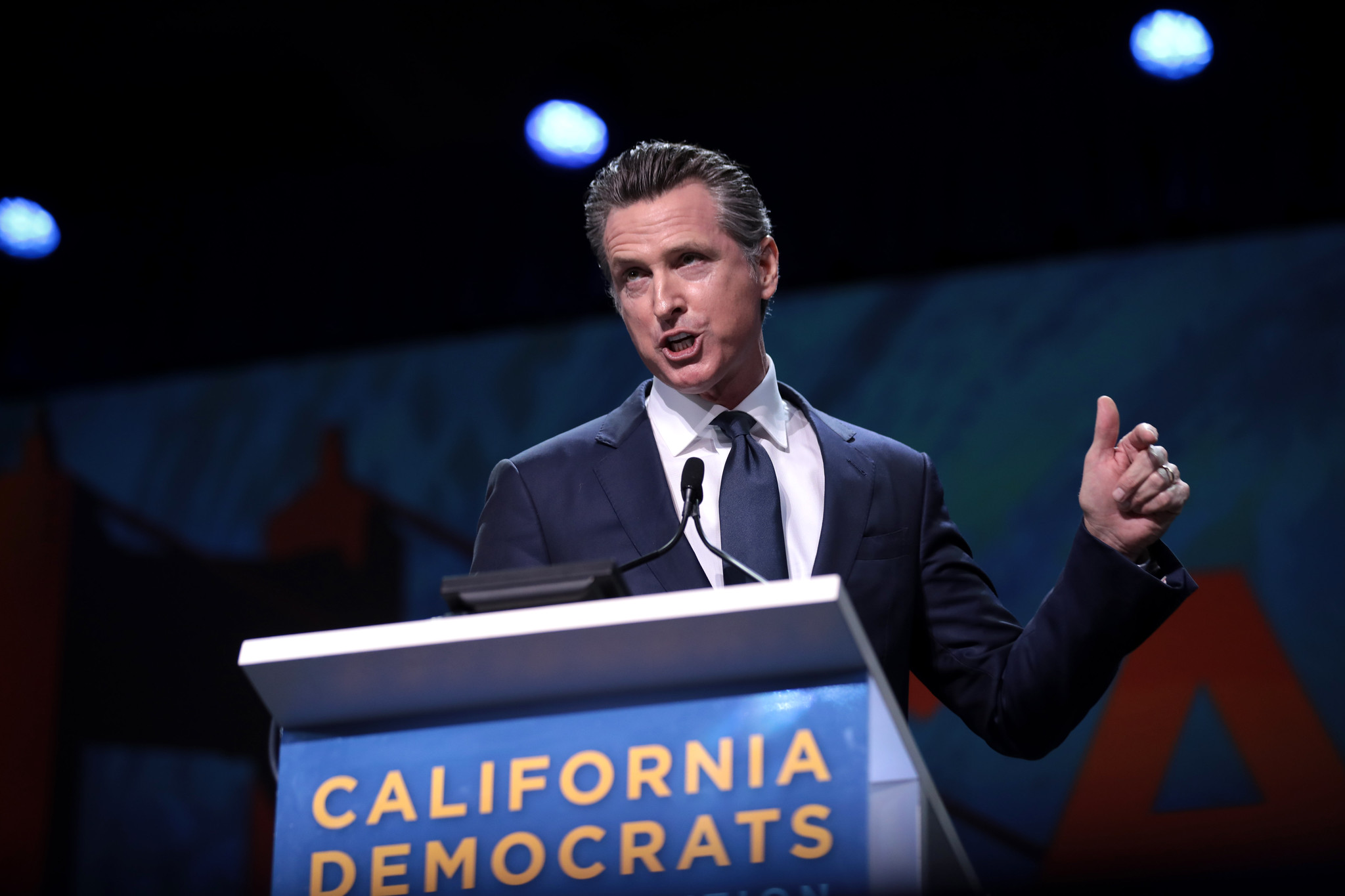
California Gov. Gavin Newsom announced Thursday that he would commute all 548 death sentences in the state to life without parole, a sweeping decision that would spare convicted child murderers and serial killers from execution.
The outgoing Democrat said his conscience compelled him to act before leaving office, but the plan faces a significant legal obstacle. California’s constitution requires state Supreme Court approval for clemency granted to anyone with more than one felony conviction.
That provision applies to 382 inmates, roughly 70 percent of those whose sentences Newsom wants to change, according to The Associated Press.
“State-sanctioned killing is incompatible with California’s values, undermines the foundations of our legal system and diminishes each of us,” Newsom wrote in an open letter to Californians.
He argued that an imperfect justice system could not carry out executions while remaining faithful to justice and human decency.
Newsom acknowledged the anguish his decision could bring to victims’ families, including those who strongly oppose clemency. He described the action as one of the most difficult of his career, but maintained it was morally necessary.
The governor wrote that announcing the decision could revive painful memories for relatives of murder victims. He said he respected those who disagreed with him, even while calling the commutations a righteous action.
The letter also set out his personal justification for changing the death sentences imposed by courts. Newsom said he felt compelled by his conscience to take the action for California’s welfare.
🗳️Turning Point PAC is deploying the largest ballot-chasing operation in U.S. History to secure key battleground states. 🗳️ Keep our grassroots army in the field and protect future victories! ➡️➡️➡️ DONATE TODAY!!! 🇺🇸🇺🇸🇺🇸
Newsom also wrote that society would be stronger if it rejected state-sanctioned killing.
The proposed commutations include Charles Ng, convicted in 1999 of murdering six men, three women and two male infants. Ng and accomplice Leonard Lake committed their crimes at a remote cabin in Northern California.
Richard Allen Farley would also be spared execution under Newsom’s plan. Farley killed seven people and wounded four in a 1988 workplace shooting at ESL Inc. in Sunnyvale after stalking a former coworker.
Newsom has opposed executions throughout his governorship. He imposed a moratorium shortly after taking office in 2019, and California has not executed an inmate since 2006.
Commutation to life without parole would permanently change the affected sentences, subject to the legal approvals required for individual cases.
The governor’s approach stands in contrast to states that continue to use capital punishment. Rather than restart executions that have been halted for two decades, Newsom is seeking to replace every remaining death sentence with an imprisonment term that would not allow parole.
The announcement came on a day when three other states carried out executions. Indiana put Jeffrey Weisheit, 50, to death for starting a 2010 house fire that killed his girlfriend’s children, ages eight and five.
Florida executed Jesse Guardado, 64, who confessed and pleaded guilty to fatally stabbing a 75-year-old woman who had helped him find work and housing.
Alabama executed Michael Taylor, 54, for beating an older couple to death with a metal bar during a robbery in 1991. It was the second day this year on which three inmates were executed in the United States.
As Newsom prepared to leave office, California’s incoming Democratic governor, Xavier Becerra, used his first post-election speech to confront the Trump administration over immigration enforcement.
Becerra, who won Tuesday’s election, promised to defend Californians against policies he considers hostile to immigrants and explicitly criticized Immigration and Customs Enforcement.
His remarks came as he prepared to succeed Newsom, whose death penalty announcement concerned the final period of his own administration.
His speech offered no detailed proposal to change deportation policy, but repeatedly framed immigration enforcement as a question of freedom and belonging.
“The California dream is universal. It’s non-negotiable. And yes, it is undeportable,” Becerra told supporters.
The governor-elect warned that anyone coming after California or its residents should expect resistance. “There’s a new sheriff in town,” he declared, invoking both his law degree and union membership.
Becerra listed access to health care, union organizing, bodily autonomy, clean water and public safety among the freedoms he wanted to defend. He also invoked the right to a free election and the ability to live without fear of violence.
Those promises formed part of a broad campaign-style declaration rather than a detailed legislative agenda. He included immigration authorities among the dangers he saw on California’s streets.
“Freedom to walk the streets without fear of gun violence or ICE mercenaries. And freedom tonight to hold a free election,” he told the crowd.
The language was Becerra’s political characterization of federal agents, not a finding about the conduct of individual officers. He did not outline specific steps his administration would take against federal immigration enforcement.
California voters, meanwhile, rejected a ballot initiative that would have tightened identification requirements at the polls, according to a Decision Desk HQ projection.
Proposition 39 would have required registered voters to establish U.S. citizenship and mail voters to supply the final four digits of a government-issued identification number.
The measure also would have prohibited voting in person without an ID. Nearly 60 percent opposed it, compared with about 41 percent in favor, according to the reported results.
California already requires eligible adults to provide identification and a Social Security number during voter registration. Proposition 39 would have added requirements at the point of voting, including for people who cast ballots by mail.