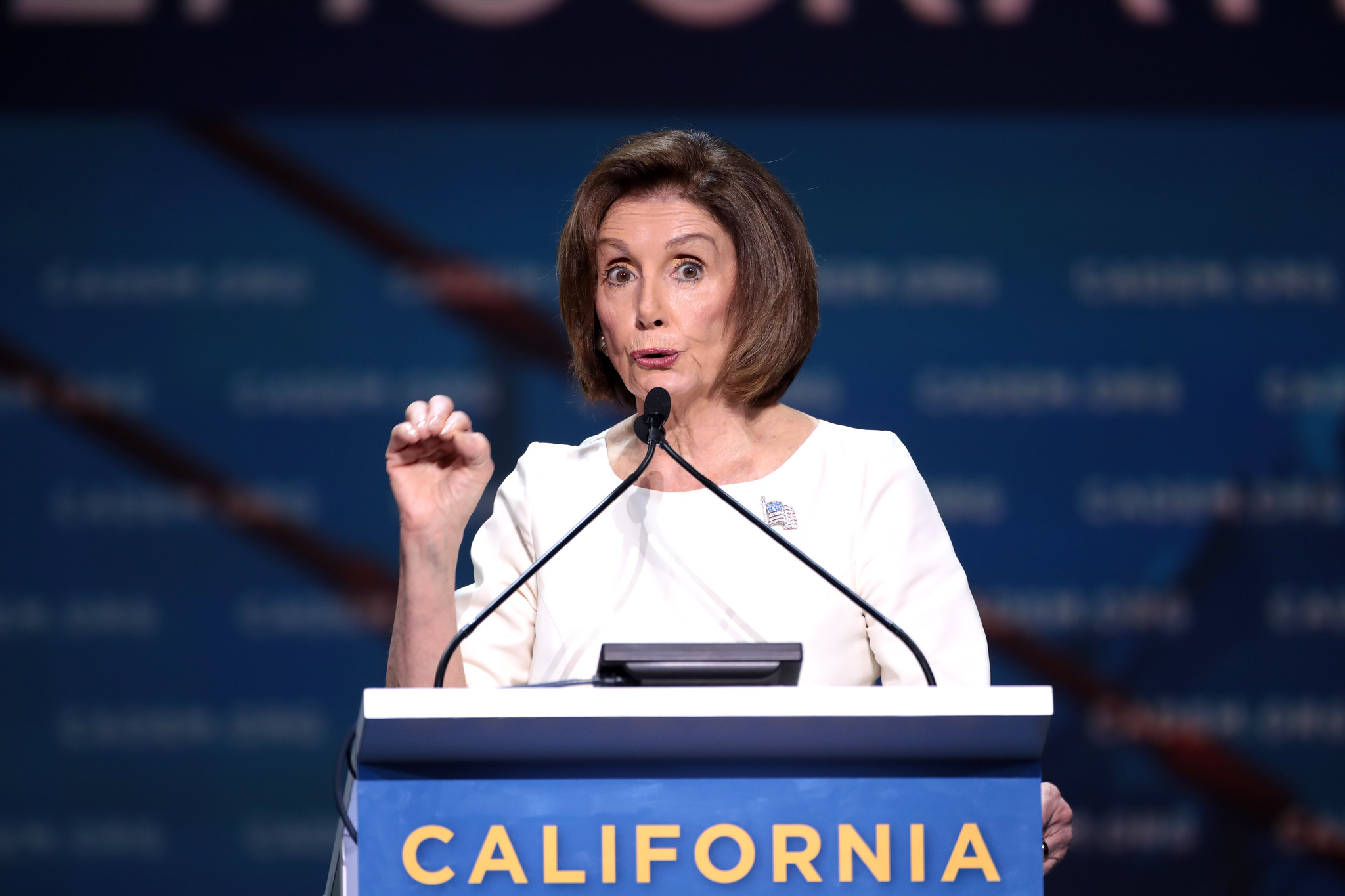
Former House Speaker Nancy Pelosi (D-CA) rejected the positions taken by two prominent progressive Democrats on Israel, declaring that their remarks were “wrong” and did not represent the views of Democrats serving in Congress.
Pelosi delivered the criticism Thursday on Donny Deutsch’s “On Brand” podcast after the host questioned how Jewish voters could support a party that included New York City Mayor Zohran Mamdani and Michigan Democratic Senate candidate Abdul El-Sayed.
Deutsch described statements challenging Israel’s right to exist as a Jewish state as antisemitic and pressed Pelosi to address the positions of the two politicians.
“No, it’s more than concerning,” Pelosi responded. “It’s wrong. It’s wrong. And it isn’t a reflection of the Democrats in the Congress of the United States.”
The former speaker had previously maintained during the conversation that she was unaware of anyone among congressional Democrats personally participating in antisemitism.
She nevertheless allowed that certain statements could be understood that way, even if their authors did not characterize them as such.
Her objection to Mamdani and El-Sayed concerned their public positions rather than an accusation that either politician personally engaged in antisemitism.
Mamdani has argued against giving one religious group a preferred status within a country’s governing identity, extending that principle beyond Israel to other nations.
During a June 28 conversation with ABC News, the future New York City mayor was asked to address Israel’s identity as a Jewish state.
🎓Support Defending Education’s mission to expose political agendas in America’s classrooms and restore quality education for all! 🎓 Help protect students and strengthen education nationwide ➡️➡️➡️ DONATE TODAY!!! 🇺🇸
“I think any state that privileges one religion over the other is one that I can’t tell you I support, whether it be Israel or Saudi Arabia or anywhere else,” he explained.
Although Mamdani accepted Israel’s existence as a country whose residents should enjoy equal rights, he stopped short of affirming its Jewish identity. Earlier questions on the subject had also gone without a direct endorsement.
His opposition to Israeli government policies has extended to the use of American public funds in connection with military operations in Gaza.
In a message marking three years since the October 7 attacks, Mamdani maintained that US taxpayers were financing conduct he characterized as war crimes.
He accused Israel of genocide, estimating Palestinian deaths at more than 74,000, including over 21,000 children. He also cited attacks involving ambulances, civilian housing and journalists, as well as restrictions on food entering Gaza.
The death toll and accusations reflected Mamdani’s own assertions rather than independently established findings in the reporting.
El-Sayed has approached questions about Israel’s identity by arguing that Palestinian political rights deserve equal consideration in discussions of the country’s future.
He has criticized Israeli policies affecting Palestinians in the West Bank, east Jerusalem and Gaza, including what he characterized as the denial of rights following displacement dating to Israel’s establishment in 1948, Jewish Insider reported.
The Michigan Senate hopeful also questioned Washington’s financial backing of Israeli officials whom he accused of resisting a two-state settlement.
At a May meeting with Jewish supporters, El-Sayed expressed difficulty endorsing Israel’s status as a Jewish state because he questioned whether that arrangement could be reconciled with liberal democratic values.
“Israel exists as it stands, but nobody ever asked me about the right of Palestine to exist, because it doesn’t exist,” he argued.
Deutsch raised the two politicians’ positions during his conversation with Pelosi, prompting her to distinguish their remarks from those of Democrats in the House.
Despite criticizing Mamdani, Pelosi expressed a desire to see him succeed in leading New York City.
“This new person in Michigan, we’ll see if he gets elected to the Congress,” she continued, referring to El-Sayed.
Pelosi maintained that lawmakers speak for their own constituencies and that the party’s congressional position should not be defined by every statement made by individual Democrats.
“People represent their districts, and we have to respect that,” she explained.
She cited House Minority Leader Hakeem Jeffries when discussing the distinction between the positions of particular politicians and the views held by House Democrats collectively.
El-Sayed has encountered criticism on another front through his decision to appear alongside streamer Hasan Piker during an April series of events at Michigan colleges.
Piker has previously drawn criticism for statements that America deserved the September 11 attacks, derogatory comments about Jews and accusations that Israel operates an apartheid system.
El-Sayed declined to repudiate those remarks during the campus appearances, instead defending his choice to speak with people who follow the streamer’s programming.
“At the end of the day, I’m not policing platforms,” he explained.
He credited Piker with building an audience among people who believe conventional political institutions have excluded them from public debate.
Rep. Rashida Tlaib (D-MI) has separately challenged criticism of El-Sayed involving his reported history of claiming Egyptian citizenship and allegations concerning his family’s associations with the Muslim Brotherhood.
In footage obtained through an undercover conversation and published Wednesday by Townhall, Tlaib rejected suggestions that those allegations warranted treating the Senate candidate as a terrorist.
“Obviously they’re targeting [El-Sayed], trying to – they’re not talking about his politics,” she maintained.
Tlaib contrasted reactions to his reported Egyptian nationality with how she believed people would respond if he had previously claimed French citizenship.
Questions about his family arose in connection with reports that El-Sayed had endorsed a 2012 appeal urging Egypt’s then-Muslim Brotherhood president to remove figures from the media and police.
His half-sister had also reportedly described a history of involvement in the organization among relatives, including their mother. Neither allegation, as presented, establishes that El-Sayed was a member of the group or involved in terrorism.
Tlaib disputed the attempt to associate him with terrorism and recalled encountering questions about Barack Obama’s religion while speaking with voters, arguing that a person’s religious identity should not be treated as disqualifying.
She also invoked El-Sayed’s sister while rejecting the suspicions surrounding his family.
“His sister, by the way, his sister is a professor at a university, and like, if that was true, like, I don’t think she’d be working in a school,” she added.