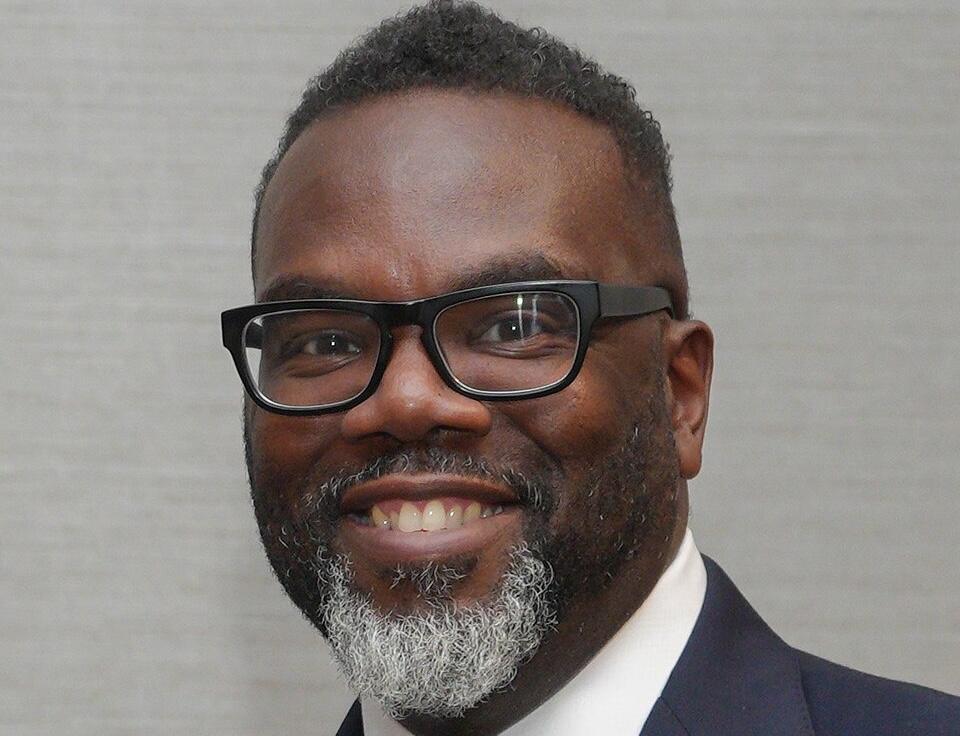
The White House told Chicago Mayor Brandon Johnson to focus on his city’s homicide rate instead of pushing race-based reparations after he accused President Donald Trump of lining the pockets of the richest Americans while ignoring descendants of enslaved people.
“Government programs that dole out money based on race are illegal,” a White House spokesperson told Fox News.
“Chicago would be better served if Mayor Johnson focused more on lowering his city’s homicide rate instead of advocating for divisive, unconstitutional government action.”
Johnson went after Trump during a Sunday interview on “Native Land Pod,” after hosts Angela Rye, Bakari Sellers and Andrew Gillum confronted him with the president’s criticism of Chicago’s crime problem.
Trump had portrayed the city as overwhelmed by worsening violence in an October 6 Truth Social message, questioning why Illinois officials had not asked Washington to step in.
Johnson had a very different assessment. Chicago’s violent crime figures have dropped considerably, according to the city’s police department and the mayor’s administration, and Johnson credited efforts that extend beyond traditional law enforcement.
The mayor argued that public safety requires more than policing, pointing to Chicago’s spending on behavioral and mental health care alongside efforts to strengthen detective staffing and support community programs working to prevent violence.
But Johnson’s response to Trump went well beyond crime statistics, accusing the president of putting the wealthiest Americans first while overlooking the demands of people whose ancestors endured slavery.
🗳️Turning Point PAC is deploying the largest ballot-chasing operation in U.S. History to secure key battleground states. 🗳️ Keep our grassroots army in the field and protect future victories! ➡️➡️➡️ DONATE TODAY!!! 🇺🇸🇺🇸🇺🇸
“He’s so sorry. It’s real pathetic, right, because it’s so disingenuous … This is the president who just released the largest upward transfer of wealth into the hands of the ultrarich at the expense of the demands of those of us who are descendants of the formerly enslaved,” Johnson told the podcast hosts.
The mayor argued that money benefiting wealthy Americans came at the expense of education, housing, medical care, transportation and jobs offering decent wages, all of which he connected to demands made by formerly enslaved people.
Johnson also questioned Trump’s commitment to fighting violence, pointing to what he described as an $800 million reduction in prevention spending.
He separately accused the administration of shrinking the Bureau of Alcohol, Tobacco, Firearms and Explosives budget by nearly a third.
He questioned why the president was concentrating on immigration-related border issues while Chicago continued trying to keep unlawfully obtained firearms off its streets.
“He cut the ATF budget by 30%,” Johnson explained. “My local police department has worked in tandem with the AFT to get illegal weapons off the streets of Chicago. This year alone, we have removed almost 9000 illegal weapons off the street.”
The White House rejected Johnson’s racial-policy argument, with spokeswoman Allison Schuster defending Trump’s campaign to eliminate diversity, equity and inclusion practices across the federal government.
“President Trump was resoundingly elected with a mandate to end divisive, racist policies and restore merit and efficiency,” Schuster told the outlet.
She blamed DEI programs under former President Joe Biden for narrowing hiring opportunities, increasing business expenses and creating workplace inefficiencies.
Schuster insisted the administration supports the same legal protections for all Americans, regardless of ethnicity or race.
Just north of Chicago, Evanston’s reparations effort has already provided financial help for housing, although the program now faces a legal challenge.
Since 2021, eligible Black residents and their direct descendants have been able to receive housing-related grants of up to $25,000, paid for with taxes on recreational marijuana sales.
Evanston allocated $20 million to the initiative and has distributed more than $7 million. Earlier this year, its Reparations Committee gave another 44 residents the go-ahead for funding.
Other governments have pursued different methods of addressing slavery’s legacy, including a new California law requiring major businesses to investigate their historical records.
California Gov. Gavin Newsom (D-CA) signed Assembly Bill 2599 last week, making companies’ historical involvement in slavery-related transactions subject to public disclosure. Democratic Assemblymember Isaac Bryan (D-CA) authored the legislation.
The law targets companies operating in California with more than $100 million in annual worldwide revenue, provided they existed before the end of 1964 or inherited operations from a business that did.
Rather than demanding direct payments, California is requiring those companies to examine whether their predecessors bought or sold enslaved people, insured slavery-related transactions or used enslaved people to secure loans.
The requirements will take effect once the Legislature provides funding. Businesses must then document their searches in affidavits signed under penalty of perjury, even if their research uncovers no qualifying transactions.
The disclosures will be made available through a state website. Companies operating in California on January 1, 2028, must submit their first filings by January 15, 2029, although that deadline could change if the website is not ready.
International pressure for slavery reparations has also intensified through the United Nations, where a committee is demanding financial compensation rather than simply the disclosure of historical records.
On Monday, the Committee on the Elimination of Racial Discrimination called for immediate payments to people of African descent and suggested additional measures, potentially including commissions examining the historical record.
The committee pointed to obligations under a 1965 convention on racial discrimination. Reuters reported that its position rests on the commitments countries made under that treaty, regardless of what laws existed during the centuries when Africans were enslaved and traded.
The committee described its approach as a “paradigm shift,” pressing countries to act on reparations rather than continue debating responsibility for centuries-old abuses.
United Nations estimates put the number of Africans taken and sold between the 15th and 19th centuries at roughly 12.5 million.
The committee identified 182 countries as having reparations obligations, including the United States, United Kingdom, France and Portugal.