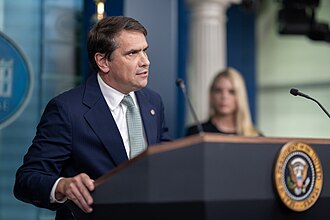
Todd Blanche finally got the attorney general title in the middle of a Senate brawl that exposed Republican unrest over his Justice Department record.
The Senate confirmed Blanche early Saturday in a 50 to 49 vote, ending a late-night fight that ran until 4 a.m. and sent two Republican senators across the aisle to oppose President Donald Trump’s pick.
Sens. Susan Collins of Maine and Lisa Murkowski of Alaska joined Democrats against Blanche, turning what should have been a routine Republican confirmation into a one-vote escape.
Collins said before the vote that her objection came down to what she described as an increasingly political Justice Department.
“Mr. Blanche has taken several actions that have further eroded the Department’s independence, and that is the basis for my vote to oppose his confirmation,” Collins said in a statement earlier this week.
I will support Todd Blanche for U.S. Attorney General. pic.twitter.com/PKWr3atuvA
— U.S. Senator Bill Cassidy, M.D. (@SenBillCassidy) August 7, 2026
Her complaints included Blanche’s approval of an IRS order involving audits of the Trump family and its businesses, along with the creation of a $1.8 billion anti-weaponization fund.
Murkowski raised similar objections and also criticized the department’s handling of the Epstein files release.
Blanche survived because Sen. Bill Cassidy of Louisiana, who had previously opposed the nomination, moved into the yes column on Friday.
🪖Seventeen battle-tested candidates are ready to strike a decisive blow to the Democrat Machine — but they urgently need resources. 🪖 Join the grassroots push to save the House Majority and back them today! ➡️➡️➡️ Make a 17X impact!!! 🇺🇸🇺🇸🇺🇸
That switch became decisive once Collins and Murkowski broke ranks.
Cassidy did not try to sell Blanche as flawless. He argued that the Senate was choosing between a confirmed attorney general and another temporary leader at the Justice Department.
“Mr. Blanche is not perfect, and he will tell you this,” Cassidy said. “But the choice is not between perfection and Mr. Blanche.”
“It is between Mr. Blanche and another acting attorney general who may not run the department effectively under President Trump, and who indeed may not be as good as Mr. Blanche.”
Cassidy said a Senate-confirmed attorney general would carry more weight inside the department and be better positioned to resist political pressure than someone merely holding the job on an acting basis.
After the vote, Blanche thanked senators for staying late and praised Trump.
“I am deeply honored by the trust and confidence President Trump has placed in me to lead the Department of Justice as our great nation’s 88th Attorney General,” he said.
The confirmation came as the Senate rushed through a pile of unfinished business before leaving Washington for its August break.
Trump did not get everything he wanted. The Senate left town Saturday without passing his Safeguard American Voter Eligibility America Act, one of his legislative priorities.
The measure would require proof of citizenship to register to vote and photo identification to cast a ballot.
Republican Sens. Ron Johnson of Wisconsin, Mike Lee of Utah and Rick Scott of Florida backed away from a planned budget resolution for Reconciliation 3.0 after concluding late Friday that the votes were not there, The Hill reported.
Instead, Republicans secured a vote on a federal election photo ID requirement sponsored by Republican Ohio Sen. Jon Husted.
Every Democrat opposed the measure, which received 52 votes, falling short of the 60 needed to move forward.
Johnson said the senators had spoken with Trump by phone Friday.
“Obviously, with the president at his direction, this is what he wants to do,” Johnson said, according to Scripps News.
Trump had pushed for the election bill in a Thursday interview with Punchbowl News.
“[The] SAVE America Act is a very important thing,” Trump said. “John’s trying. He’s trying hard. I really believe that. But if he doesn’t get there, it would be unfortunate.”
The delayed $95 billion reconciliation package was meant to advance election integrity priorities, pay for the Iran war and send aid to farmers.
Senate Majority Leader John Thune rejected Trump’s push to cancel the August break so lawmakers could stay in session and pass the election integrity bill.
The Senate had also departed for a two-week break in late June while the SAVE America Act remained stalled.
Even as the election bill failed to advance, senators did approve a temporary government funding measure aimed at avoiding another shutdown before the midterm election.
The Senate passed the continuing resolution 90 to 6 early Saturday and sent it to the House, which is scheduled to return Aug. 31. Federal funding expires Sept. 30 unless Congress acts.
Sen. Darline Graham of South Carolina voted present because the the resolution included a death benefit for the heir of her brother, the late Sen. Lindsey Graham of South Carolina.
Sens. Bill Cassidy, Tim Kaine, Ed Markey, Rand Paul, Bernie Sanders and Elizabeth Warren voted no.
The funding bill had been slowed by a White House-backed provision that delayed a ban on hemp-derived THC products until December.
The legislation also included a provision sought by Democrats and some Republicans on the Appropriations Committee, including Collins, to temporarily block a White House budget office rule that would give political appointees in the executive branch more say over how federal grants are distributed.
Collins, who chairs the Senate Appropriations Committee, called that rule “deeply flawed.”
Another fight involved college sports legislation from Senate Commerce Committee Chairman Ted Cruz and Sen. Maria Cantwell.
The final agreement to speed up the government funding vote came after Cruz agreed to push floor consideration of the Protect College Sports Act until September.
The hemp dispute produced another Senate vote before lawmakers left town.
Senators voted 61 to 32 to table a bipartisan amendment from Sen. Ted Budd and about a dozen other senators that would have removed the federal ban on most hemp-derived THC products from the temporary funding bill.
Hemp industry groups and their allies viewed the delay as a win because it gives them more time to press lawmakers for regulation instead of prohibition.
Trump signed the ban into law last year as part of a larger spending bill to reopen the government after a record-long shutdown. It had been set to take effect Nov. 12.
The law redefined hemp to close what critics called the “hemp loophole” created after the 2018 Farm Bill removed hemp from the controlled substances list. The change was championed by Sen. Mitch McConnell.