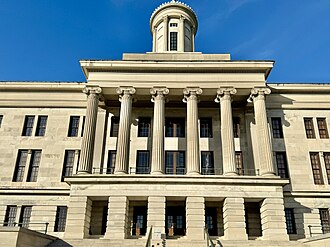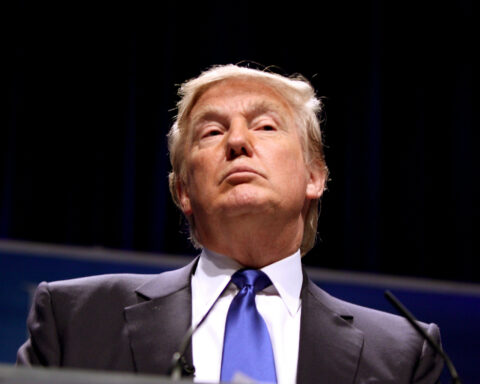
Marsha Blackburn won the Tennessee Republican governor’s race Thursday night with a noticeable name missing from her corner.
President Donald Trump never endorsed her.
The Tennessee senator still came out ahead of four-term U.S. Rep. John Rose and state Rep. Monty Fritts, securing the GOP nomination in a state where the Republican nominee enters the fall with a heavy built-in advantage.
Blackburn is trying to move from the Senate to the governor’s mansion shortly after winning a second Senate term. A November victory would make her the first woman elected governor of Tennessee.
The race was called by Decision Desk HQ at 9:24 p.m. ET. At that point, more than 60 percent of the vote had been counted and Blackburn had 43 percent.
Decision Desk HQ projects Marsha Blackburn wins the TN Governor Republican Primary#DecisionMade: 9:24 PM EDT pic.twitter.com/sYTHZBKqlk
— Decision Desk HQ (@DecisionDeskHQ) August 7, 2026
Her likely Democratic opponent is Jerri Green, the Shelby County public defender and Memphis City Council member projected to win her party’s primary Thursday.
Tennessee has not elected a Democrat to statewide office since 2006, and the state backed Trump in all three of his presidential runs.
Blackburn campaigned as a known conservative brand in a state that already knew her politics.
🗳️Turning Point PAC is deploying the largest ballot-chasing operation in U.S. History to secure key battleground states. 🗳️ Keep our grassroots army in the field and protect future victories! ➡️➡️➡️ DONATE TODAY!!! 🇺🇸🇺🇸🇺🇸
Her launch message promised jobs, energy production, stronger parental rights in education and the removal of undocumented immigrants.
“We’ll honor the Constitution, we’ll value life, and we’ll define our boys and girls the way God made them,” Blackburn said.
She also promised leadership that would make Tennessee “America’s conservative leader for this generation and the next.”
Blackburn’s most viral campaign ad put her at a Chinese restaurant, cracking fortune cookies as promises from her campaign appeared.
“It doesn’t take a fortune cookie to figure it out: here in Tennessee, we’re going to stop Communist China and protect Tennessee land.”
The issue was not new territory for Blackburn. Her China warnings in Congress date back to 2003, when she recognized the threat of Chinese intellectual property theft. The ad also said she would work with the Trump administration to continue the fight.
Blackburn was criticized before Election Day for skipping debates and limiting media access, and polls suggested the race had tightened.
But one internal survey published by The Tennessean in July had shown her far ahead of Rose, 51 percent to 20 percent.
Rose tried to make the contest about local priorities and rural Tennessee.
He campaigned on his farming roots while attacking a $30 million incentive package for a Starbucks corporate expansion in Nashville. Rose argued that the money should instead support small businesses and core state services.
His own campaign spending became a weapon for Blackburn’s side. Rose funded about 85 percent of his campaign himself, prompting Blackburn strategist Ward Baker to tell The Tennessean that the governor’s office “is not for sale.”
Fritts ran with a much smaller financial footprint and made religious issues central to his campaign.
He vowed to seek a First Amendment stopgap that would allow mosques and other non-Christian religious groups to be banned.
The open contest to replace Republican Gov. Bill Lee helped draw strong early voting interest from both parties.
So did the state’s redrawn political landscape after Tennessee’s legislature eliminated its last Democratic congressional district.
Blackburn entered the governor’s race with support from several Tennessee Republicans, including Reps. Tim Burchett, Chuck Fleischmann and Matt Van Epps, plus former Rep. Jimmy Duncan.
Her résumé in Washington stretches back more than two decades. Blackburn first won her Senate seat in 2018 after 16 years representing Tennessee’s 7th Congressional District in the House.
Rose’s run for governor also opened a House race.
State Rep. Johnny Garrett won the Republican primary for the U.S. House seat Rose is leaving behind, according to Decision Desk HQ.
Garrett defeated Marine veteran Jon Henry and former U.S. Rep. Van Hilleary after serving as Tennessee House majority whip since 2019.
His November opponent in Tennessee’s 6th Congressional District will be Mike Croley, the Democratic nominee and former park ranger.
Another Tennessee Republican lost his primary Thursday night.
Rep. Andy Ogles, R-Tenn., was defeated by Charlie Hatcher, a farmer, physician and former state commissioner of agriculture.
Hatcher’s backers included former Agriculture Secretary Sonny Perdue, former Tennessee Gov. Bill Haslam and former Rep. Zach Wamp, R-Tenn.
Hatcher’s campaign website turned Trump’s work ethic into a farmer joke while needling Ogles.
“Trump would have been a fantastic farmer because he has that work ethic. But it might not be enough money for him!”
The same page argued Trump could accomplish more if Ogles spent less time talking and more time doing.
Hatcher’s campaign video leaned on the same pitch, casting him as a farmer-minded Republican who would back Trump and Speaker Johnson.
“I think there’s something missing in Washington. There’s a lack of farmer common sense. There’s a lack of work ethic,” Hatcher said.
He also described himself as focused on problem-solving, collaboration and supporting the Trump administration and Speaker Johnson’s agenda.
Hatcher is expected to face Columbia Mayor Chaz Molder in November.
Molder won the Democratic primary over former educator Carrie Ann Iacomini, Memphis City Council member Yolanda Cooper-Sutton, writer Rachel Hurley and local activist Devante R. Hill.