
A doomed Israel-aid vote turned into a Democratic pressure test Wednesday, with nearly as many House Democrats voting to cut off U.S. assistance as those voting to keep it in place.
Rep. Thomas Massie, R-Ky., lost the floor fight by a wide margin, 104-314-10, but the numbers inside the Democratic column told the real story.
The yes side was almost entirely Democratic, with Massie as the lone Republican supporter. A total of 103 Democrats joined Massie, while 98 Democrats voted no and 10 others avoided either side with a present vote.
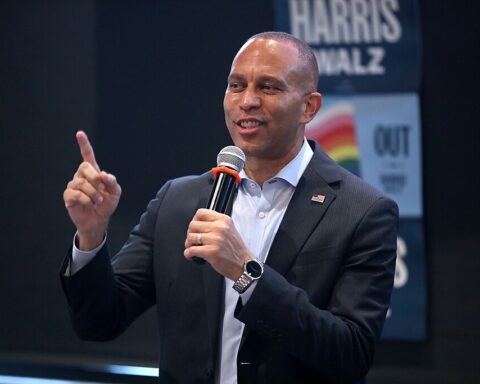
There was no unified signal from the top of the caucus. House Minority Leader Hakeem Jeffries, D-N.Y., and House Democratic Caucus Chair Pete Aguilar, D-Calif., rejected the amendment, while House Democratic Whip Katherine Clark, D-Mass., backed it. Former Speaker Nancy Pelosi, D-Calif., also voted yes.
The 10 Democrats who voted present were Reps. Ami Bera of California, Shontel Brown of Ohio, Janelle Bynum of Oregon, Sarah Elfreth of Maryland, Jared Huffman of California, Betty McCollum of Minnesota, Kelly Morrison of Minnesota, Chris Pappas of New Hampshire, Linda Sánchez of California and Mike Thompson of California.
Massie’s proposal went after the Israel money inside the fiscal year 2027 State Department and national security funding bill, barring those funds from being used for Israel while reducing foreign military financing by the same $3.3 billion set aside for the country.
Massie described Israel as the “biggest welfare recipient of the United States.”
Democratic opponents argued the amendment would sweep up more than military assistance.
🎓Help millions think clearly and communicate with power through Hillsdale College’s free “Classical Logic and Rhetoric course! 🎓 Expand education for liberty and equip the next generation ➡️➡️➡️ TAKE THE FREE COURSE NOW!!! 🇺🇸🇺🇸🇺🇸
Jeffries warned colleagues a day earlier that the amendment reached too widely, saying it could affect humanitarian aid, refugee resettlement, peace-building work and U.S. Embassy operations.
“In my view, there are more decisive ways to achieve the urgent change necessary when it comes to the far-right Netanyahu government. Republican leaders are desperately trying to weaponize an amendment they do not support for nakedly partisan reasons,” Jeffries wrote.
Former House Majority Leader Steny Hoyer, D-Md., went further during debate on the measure.
“This amendment would embolden the enemies of peace, those pursuing the complete elimination of Israel and those who seek the death of Jews,” Hoyer said.
Clark accepted the criticism of the amendment’s design and GOP motives, then used her vote to send the opposite message.
In her Wednesday statement, Clark called the amendment too broad and accused Republicans of trying to “score cheap political points.” Despite the criticism, she still voted yes.
“However, it is clear that the status quo is not tenable. We should not provide a blank check for military aid to any country that does not comply with U.S. law, interests, and values,” Clark stated.
“The Netanyahu government has failed to meet that standard. I will be voting yes, not because I agree with the entirety of the amendment, or the GOP’s cynical motivations for its consideration, but because I believe we must change course.”
Pelosi framed her yes vote as a reluctant one, pairing support for the U.S.-Israel relationship and a two-state solution with frustration over the choice the House had been handed.
The former speaker said she remained “committed to a strong U.S.-Israel relationship and supportive of a two-state solution,” while the amendment itself “presents an unfortunate choice to the House.”
“For the good of the Israeli people and the Palestinian people, it clear that U.S. policy must change” to strive for “a just and lasting peace in the Middle East,” Pelosi added.
Pelosi said the United States should be a force for security and stability, while arguing the Netanyahu government could not stay on its current path.
“The United States must be a force for security and stability. The American people are rightly demanding an end to a perpetual cycle of war, and the Netanyahu government cannot maintain its current course. Therefore, while this amendment is ill-conceived, I vote yes for the message that it sends,” Pelosi concluded.
Rep. Joaquin Castro, D-Texas, put the argument in terms of American pressure.
“If we hope to change Israel’s behavior, we must use our leverage,” Castro stated. “The American people have seen this tragedy with their own eyes. … They do not support giving Israel more weapons.”
The House split landed the same day Sen. John Fetterman, D-Pa., was publicly drawing his own red line on Israel.
At the Hill Nation Summit in Washington, Fetterman did not announce a party switch, but he made clear what would make him reconsider.
“If our party ever becomes — and just makes it official — the anti-Israel party, that’s when I would leave because that’s been a moral clarity for me,” he asserted.
Fetterman’s frustration was aimed at Democrats moving away from an ally he described as a value-sharing democracy in the Middle East.
“My long-term concern has been with the Democratic Party, as I am a member of that, is that our party is going to back away and turn their back to Israel,” he explained.
He pointed to Clark’s vote as one sign of where he thinks the party is drifting.
“You look at the kinds of individuals that are winning our recent primaries,” he noted. “It’s becoming more anti-, anti-Israel and hostile to people” who are pro-Israel.
Fetterman also blasted Democrats who “are trying to ingratiate ourselves with that segment of the base of our voters are intensely, intensely anti-Israel.”
He revealed that Republicans have approached him about leaving the Democratic Party, but he refused to discuss the “private conversations.”
The Democratic divide over Israel was not the only partisan tension playing out Wednesday.
In the Senate, Democrats skipped the main portion of a Homeland Security and Governmental Affairs Committee hearing titled “Exposing Fraud in America.”
Ranking member Sen. Gary Peters, D-Mich., was there at the start, asked several questions and then was gone before Chairman Rand Paul, R-Ky., turned to witnesses Nick Shirley, James O’Keefe and Dylan Hedtler-Gaudette.
Other Democrats on the committee included Fetterman and Sens. Maggie Hassan, Richard Blumenthal, Ruben Gallego, Andy Kim and Elissa Slotkin.
The empty Democratic seats became part of the hearing once Sen. Bernie Moreno, R-Ohio, pointed out that witness questioning usually alternates by party.
“If there were a Democrat here, yes,” Paul replied.
“So, there’s no Democrats present at a hearing about fraud,” Moreno noted.
Paul put the absence into the record. “There doesn’t appear to be a great deal of interest across the aisle,” he acknowledged.