

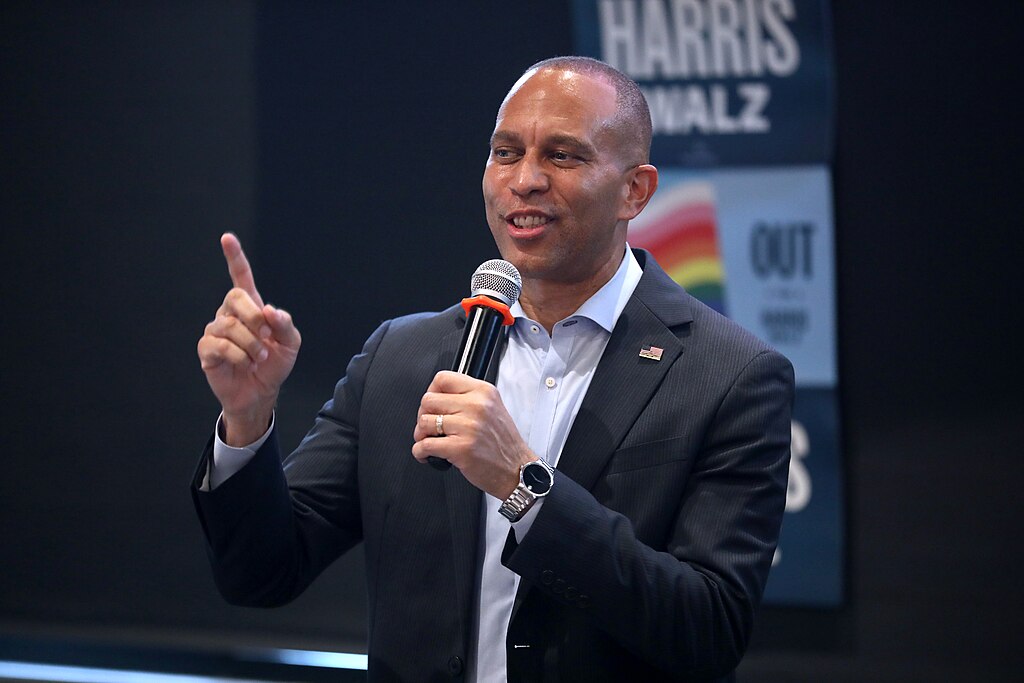
House Minority Leader Hakeem Jeffries warned President Donald Trump to “keep his reckless mouth shut” as tensions with Iran explode and gas prices surge.
Jeffries unloaded during a Sunday interview after Trump labeled Democrats the “greatest enemy” in America, a remark that quickly ignited political backlash.
The New York Democrat tied the rhetoric to rising global instability and warned it could have real-world consequences.
“Donald Trump should keep his reckless mouth shut before he gets somebody killed,” Jeffries said when pressed to respond.
The commentary came as the administration faces mounting pressure over a widening conflict with Iran, including disruptions to global oil flows and a spike in energy costs at home.
Trump had taken to Truth Social to blast Democrats, writing, “Now with the death of Iran, the greatest enemy America has is the Radical Left, Highly Incompetent, Democratic Party! Thank you for your attention to this matter. President DJT.”
Jeffries pivoted from the rhetoric to the war itself, calling it a “reckless war of choice” and pointing to fallout already hitting American wallets.
He argued the administration misjudged key developments, including Iran’s move to choke off a critical shipping route.
“They clearly didn’t anticipate some of the things that have happened, including the closure of the Strait of Hormuz,” Jeffries said, adding that “gas prices are through the roof.”
He connected the surge to wider economic strain, claiming Americans are already grappling with high costs tied to Trump’s policies. The conflict, he argued, has only intensified those pressures.
Jeffries stopped short of committing to support or oppose future Pentagon funding tied to the conflict, signaling internal discussions are still unfolding.
“We’ll have that leadership conversation when we actually have a piece of legislation that is in front of us,” he said, while noting “there is strong opposition right now” to continuing the conflict.
He pointed to a growing push within his party to force a vote aimed at limiting the president’s authority.
“We need to move, which we plan on doing in short order, a War Powers Resolution so we can bring this situation to a close,” Jeffries added.
While Democrats weigh their next move, the Trump administration is racing to contain the economic fallout from the crisis.
🚨 VENEZUELAN DICTATOR NICOLAS MADURO IN U.S. CUSTODY 🚨 Do you AGREE Trump made America STRONG again??? ➡️➡️➡️ TAKE THE FREEDOM POLL NOW and stand with President Trump!!!🇺🇸🇺🇸🇺🇸
Officials outlined a plan to ease pressure on global oil markets by allowing Iranian crude already at sea to reach buyers.
U.S. Ambassador to the United Nations Mike Waltz described the strategy as flipping Iran’s own tactics against it.
The plan would temporarily lift sanctions on roughly 140 million barrels of oil currently loaded on tankers, increasing supply without direct intervention in markets.
“Now they can go to places like India, Bangladesh or elsewhere,” Waltz said, explaining the shipments could be redirected away from their original destinations.
He stressed that financial restrictions would remain intact, limiting Tehran’s ability to profit.
“The sanctions on the banks are still in place, so we do not anticipate Iran sees any of that money,” Waltz added. “This is actually, as the secretary said, using their strategy against them.”
Waltz accused Iran of attempting to destabilize global energy supplies after suffering military setbacks.
He framed the administration’s response as part of a broader effort to counter that pressure, alongside domestic energy policies and shipping waivers.
“We are going to defeat this strategy,” Waltz said. “It will be temporary on the part of Iran and, at the end of the day, the United States and our global coalition will prevail.”
The stakes have escalated sharply in recent weeks as traffic through the Strait of Hormuz slowed to a crawl following Iranian military actions.
Reports of attacks on commercial vessels and naval mines have rattled shipping lanes that handle a significant share of the world’s oil.
Markets reacted quickly, with prices climbing on fears the disruption could drag on.
The narrow waterway remains one of the most critical chokepoints in global energy supply, and even limited interruptions have sent shockwaves through the system.
Trump signaled confidence that reopening the route would not require a prolonged effort, describing it as manageable with the right resources.
“It’s relatively safe … you need ships, you need volume,” he said, calling it a “simple military maneuver.”
At the same time, the president blasted NATO allies for failing to act more aggressively.
“NATO could help us, but they so far haven’t had the courage to do so,” Trump said, after earlier calling the alliance “cowards.”
Despite the criticism, more than 20 countries have lined up in opposition to Iran’s actions, issuing a joint statement condemning attacks on commercial vessels and the effective shutdown of the strait.
“We condemn in the strongest terms recent attacks by Iran on unarmed commercial vessels … and the de facto closure of the Strait of Hormuz,” the statement read.
The coalition signaled a willingness to step in to secure shipping lanes, raising the possibility of a broader multinational response.
That potential involvement has not eased tensions, as Iranian officials continue to push back on U.S. demands.
Iran’s foreign minister claimed restrictions have only targeted nations involved in attacks, while warning of further escalation if strikes continue.
Tehran has also threatened to hit energy infrastructure across the region, raising fears of a wider conflict.
Trump raised the stakes further over the weekend by issuing a 48-hour ultimatum demanding the strait be reopened. He warned of direct strikes on Iranian power facilities if the deadline is ignored.
“If Iran doesn’t FULLY OPEN, WITHOUT THREAT, the Strait of Hormuz, within 48 hours from this exact point in time, the United States of America will hit and obliterate their various POWER PLANTS, STARTING WITH THE BIGGEST ONE FIRST!” Trump wrote.
Iran responded with its own warning, signaling retaliation would extend beyond U.S. targets.
Officials said energy and water systems across neighboring countries could be hit if American forces move forward.
Parliament Speaker Mohammad Baqer Qalibaf wrote that key infrastructure in the region could be “irreversibly destroyed” under that scenario.
Iran’s Revolutionary Guards added that the shipping lane would remain closed if strikes occur, declaring, “The Strait of Hormuz will be completely closed and will not be opened until our destroyed power plants are rebuilt.”
Trump also spoke with British Prime Minister Keir Starmer on Sunday as both leaders discussed the need to reopen the Strait of Hormuz to stabilize global shipping, according to Downing Street.
“They agreed that reopening the Strait of Hormuz was essential to ensure stability in the global energy market. They agreed to speak again soon.”
The call followed Trump’s criticism that Britain “should have acted a lot faster” in allowing U.S. forces to use British bases for strikes, while Starmer had maintained such action must fall under “collective self-defense” in the region.

Hakeem (no such real name, sounds islamic) never said a word when oil was $150 under Obama and $130 under biden, or when Obama attacked syria.
He’s right up there to the top of the shit pile
Then what are U doing Jeffries??
Oh, you mean Jeffries, who can’t shut his pie hole for 5 seconds to stop hating anyone with common sense.
Typical muslim, open mouth, insert foot and spew hate.
Another “gas prices are through the roof” Democrat. Where were you when Biden was in office?
Another DEMORATS that HATE AMERICA and it’s PEOPLE .