

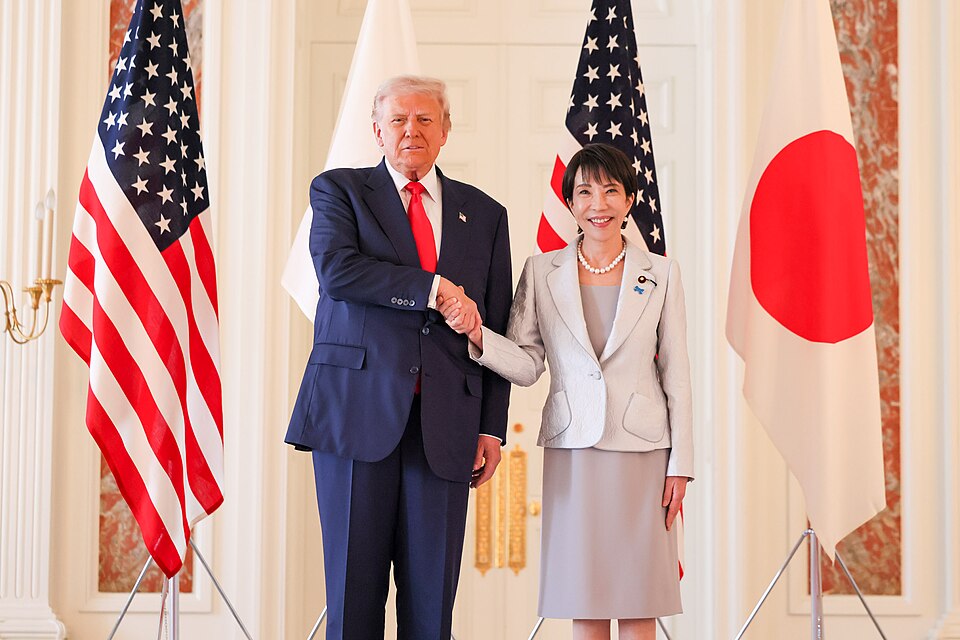
President Donald Trump praised Japan for “stepping up to the plate” on Iran while criticizing NATO allies during an Oval Office meeting with Japanese Prime Minister Takaichi Sanae.
Trump drew the contrast when asked whether Japan had provided sufficient support as tensions escalate around the Strait of Hormuz. “We’re going to be speaking about it today,” Trump said.
“We’ve had tremendous support and relationship with Japan on everything, and I believe that, based on statements that were given to us yesterday, the day before yesterday, having to do with Japan, they are really stepping up to the plate, unlike NATO.”
The remarks come as the United States presses allies to help secure shipping routes threatened by Iranian attacks.
Roughly 20 percent of global oil and gas passes through the Strait of Hormuz.
Trump has pushed countries that rely on that flow to share the burden of protecting commercial vessels.
“This should always have been a team effort, and now it will be,” Trump said earlier in the week.
Japan has signaled support while also outlining legal limits on its military role.
Takaichi told Trump the global security environment has deteriorated and warned of economic fallout tied to the conflict.
“Right now, situations in the Middle East and also the entire world, we are actually experiencing a very severe security environment,” Takaichi said.
“Also the global economy is now about to experience a huge hit because of this development.”
She credited Trump with leading efforts to stabilize the situation. “I firmly believe that it is only you, Donald, who can achieve peace across the world,” Takaichi added.
“To do so, I am ready to reach out to many of the partners in the international community to achieve our objective together.”
Takaichi reiterated Japan’s opposition to Iran obtaining nuclear weapons.
She said Tokyo has been engaging both Tehran and international partners to discourage escalation.
“In addition, Japan condemns Iran’s actions such as attacking the neighboring region, and also the de facto or effective closure of the Strait of Hormuz,” she said.
She pointed to recent diplomatic contacts between Japanese and Iranian officials.
“Foreign Minister Motegi also had the direct exchange with the Iranian foreign minister and urged Iran to stop such activities,” Takaichi noted.
Japan also brought proposals aimed at easing pressure on global energy markets.
Takaichi said discussions would include economic security cooperation in energy and rare earth minerals. She acknowledged constraints under Japan’s pacifist constitution.
Before departing for Washington, Takaichi told lawmakers her government cannot easily project force to defend the strait.
“I intend to convey these points clearly, and I’m sure the U.S. side understands these laws, given our history,” she said.
Trump has taken a harder tone toward NATO partners. In a Truth Social post Tuesday, he argued U.S. military success reduced the need for allied assistance.
“Because of the fact that we have had such Military Success, we no longer ‘need,’ or desire, the NATO Countries’ assistance – WE NEVER DID!” Trump wrote.
“Likewise, Japan, Australia, or South Korea,” he added.
“In fact, speaking as President of the United States of America, by far the Most Powerful Country Anywhere in the World, WE DO NOT NEED THE HELP OF ANYONE!”
European and Asian partners signaled a shift in tone hours before the Oval Office meeting.
Japan joined the United Kingdom, France, Germany, Italy and the Netherlands in a joint statement condemning attacks on civilian vessels.
The group pledged to “contribute to appropriate efforts to ensure safe passage through the Strait.”
Trump also addressed questions about coordination with allies ahead of U.S. strikes on Iran.
A Japanese reporter asked why partners were not notified in advance. “Well, one thing, you don’t want to signal too much,” Trump replied.
“When we go in, we went in very hard, and we didn’t tell anybody about it because we wanted surprise.”
He then referenced a historic attack during his response. “Who knows better about surprise than Japan? Okay? Why didn’t you tell me about Pearl Harbor? Okay? Right?” Trump said.
“You know, he’s asking me, ‘Do you believe in surprise?’ I think much more so than us.”
Trump argued the element of surprise shaped the early outcome of the campaign.
“And because of that surprise, we knocked out the first two days, we probably knocked out 50% of what we — and much more than we anticipated doing,” he said.
“So, if I go and tell everybody about it, there’s no longer a surprise, right?”
The president also addressed speculation about deploying ground forces.
A reporter asked whether the administration was considering sending additional troops to the region.
“No, I’m not putting troops anywhere,” Trump said. “If I were, I certainly wouldn’t tell you, but I’m not putting troops.”
His comments followed a Reuters report citing anonymous sources that the administration was weighing options to reinforce operations in the Middle East.
The report said potential plans could include securing tanker routes and expanding air and naval missions.
Some scenarios discussed by officials reportedly involved positioning forces closer to Iran’s shoreline.
Trump dismissed the need for such measures during the exchange. He also highlighted economic performance before the conflict began.
“Everything was going great. The economy was great. Oil prices were very low,” Trump said. “Gasoline was dropping to I mean, we had $1.99, 1.85; we had great everything.”
Trump said the decision to launch operations came after monitoring developments in Iran.
“And I saw what was happening in Iran, and I said, ‘I hate to make this excursion, but we’re going to have to do it,’” he said.
He acknowledged concerns about potential market impacts. “And I actually thought the numbers would be worse,” Trump added. “I thought that it would go up more than it did.”
Trump maintained the campaign will produce long-term security benefits. He said many countries share the view that Iran poses a serious threat.
“I believe every country agrees,” Trump said. “Iran is a serious threat to the world, to the Middle East, and to the world.”
He also predicted the conflict could wind down soon. “It’s not bad, and it’s going to be over with pretty soon,” Trump said.
Watch the full press conference here:

Lets leave NATO
close our offices in NATO Hq
Defund