

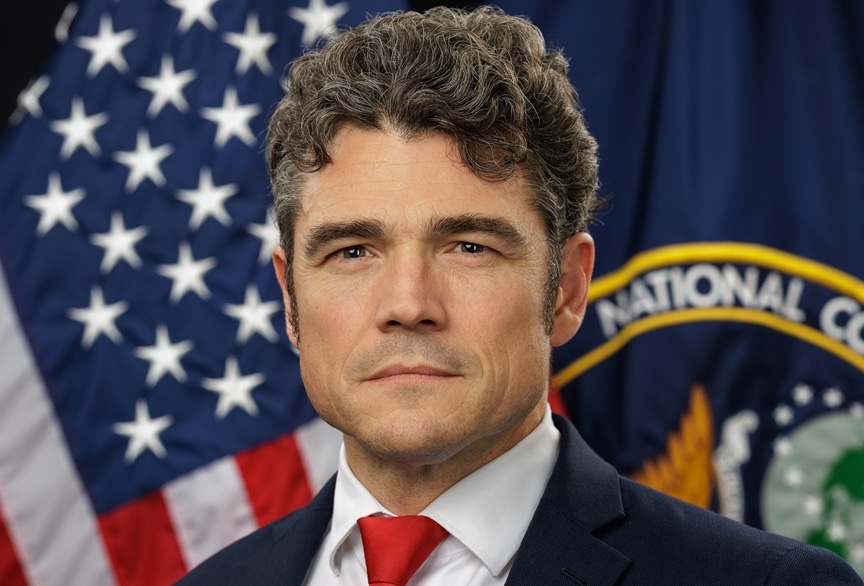
Former National Counterterrorism Center Director Joe Kent claimed Iran was not close to developing a nuclear weapon, directly contradicting the rationale behind President Donald Trump’s military campaign.
Kent made the remarks during an appearance on “The Tucker Carlson Show” Wednesday, just one day after resigning from his post.
“No, they weren’t three weeks ago when this started, and they weren’t in June either,” Kent said, rejecting claims that Iran was nearing nuclear capability.
Tucker Carlson: "Was Iran on the verge of getting a nuclear weapon?”
Joe Kent: “No. They weren't three weeks ago when this started, and they weren't in June either.” pic.twitter.com/YQX3nHOnP7
— The American Conservative (@amconmag) March 18, 2026
He pointed to a long-standing religious prohibition inside Iran as part of his argument.
“The Iranians have had a religious ruling, a fatwa, against actually developing a nuclear weapon since 2004,” Kent explained.
“That’s been in place since 2004, that’s available in the public sphere. But also we had no intelligence to indicate that that fatwa was being disobeyed or that it was on the cusp of being lifted.”
Kent’s comments clash with the Trump administration’s central justification for launching strikes against Iran.
Trump, Secretary of State Marco Rubio and other officials have repeatedly argued the operation was necessary to stop Iran from developing nuclear weapons and advancing missile programs.
The administration has not publicly detailed evidence showing an imminent threat to the United States.
A formal letter from Trump to Congress stated the strikes were intended to “neutralize Iran’s malign activities” and “advance vital United States national interests.”
Rubio acknowledged earlier this year that U.S. officials anticipated Israeli military action would trigger retaliation against American forces. He warned such escalation could lead to increased casualties.
Kent resigned Tuesday, citing what he described as a “misinformation campaign” that pushed the United States into war.
In a public statement posted on X, he argued Iran posed no immediate threat to the country.
After much reflection, I have decided to resign from my position as Director of the National Counterterrorism Center, effective today.
I cannot in good conscience support the ongoing war in Iran. Iran posed no imminent threat to our nation, and it is clear that we started this… pic.twitter.com/prtu86DpEr
— Joe Kent (@joekent16jan19) March 17, 2026
“I cannot in good conscience support the ongoing war in Iran,” Kent wrote. “Iran posed no imminent threat to our nation, and it is clear that we started this war due to pressure from Israel and its powerful American lobby.”
His resignation came just ahead of a high-profile congressional hearing on global threats led by Director of National Intelligence Tulsi Gabbard.
Gabbard responded within hours, defending the president’s authority.
“Donald Trump was overwhelmingly elected by the American people to be our President and Commander in Chief,” Gabbard wrote.
“As our Commander in Chief, he is responsible for determining what is and is not an imminent threat.”
She avoided directly answering whether intelligence supported claims of an imminent Iranian nuclear threat.
Sen. Jon Ossoff pressed her repeatedly during a Senate Intelligence Committee hearing.
🚨 VENEZUELAN DICTATOR NICOLAS MADURO IN U.S. CUSTODY 🚨 Do you AGREE Trump made America STRONG again??? ➡️➡️➡️ TAKE THE FREEDOM POLL NOW and stand with President Trump!!!🇺🇸🇺🇸🇺🇸
“Was it the assessment of the intelligence community that there was an ‘imminent nuclear threat’ posed by the Iranian regime? Yes or no?” Ossoff asked.
Gabbard declined to give a direct answer. “The only person who can determine what is and is not an imminent threat is the president,” she responded.
When pressed again, she shifted responsibility away from the intelligence community. “It is not the intelligence community’s responsibility to determine what is and is not an imminent threat,” Gabbard said.
She instead highlighted the impact of U.S. military operations. “The IC assesses that Operation Epic Fury is advancing fundamental change in the region,” Gabbard stated.
“Iran’s conventional military power projection capabilities have largely been destroyed, leaving limited options. Iran’s strategic position has been significantly degraded.”
Gabbard also faced criticism over discrepancies between her written testimony and her oral remarks.
Her prepared statement included a claim that Iran’s nuclear program had been “obliterated.” She did not read that portion during the hearing. Sen. Mark Warner challenged her decision.
“In your printed testimony today, you said Iran’s nuclear missile program was obliterated,” Warner said. “You omitted that paragraph from your opening statement.”
Gabbard responded by citing time constraints. “I recognized that time was running long,” she said.
Warner pushed back. “So you chose to omit the parts that contradict Trump?” he asked.
Trump has continued to insist Iran posed a serious threat. “They attempted to rebuild their nuclear program and to continue developing long range missiles that can now threaten our very good friends and allies in Europe,” Trump said.
He added that such capabilities could eventually reach the United States.
The president dismissed Kent’s assessment shortly after the resignation. “When I read his statement I realized that it’s a good thing that he’s out because he said that Iran was not a threat,” Trump told reporters. “Iran was a threat – every country realized what a threat Iran was.”
BREAKING: President Trump responds to the nation’s top counterterrorism official Joe Kent’s resignation in protest of U.S. military action against Iran:
“I always thought he was weak on security. Very weak on security. I didn’t know him well. But I thought he seemed like a… pic.twitter.com/dKuRfYWUh4
— Fox News (@FoxNews) March 17, 2026
“When somebody is working with us that says they didn’t think Iran is a threat – we don’t want those people,” Trump added.
Kent’s departure is also overshadowed by a federal investigation. The FBI has reportedly opened an inquiry into whether he leaked classified information.
The investigation predates his resignation and focuses on potential disclosures to unauthorized individuals.
White House correspondent Shelby Talcott reported the probe, citing multiple sources familiar with the matter. Kent has not publicly addressed the details of the investigation.
His resignation letter drew additional criticism from Republican leaders. Sen. Mitch McConnell condemned the document in a public statement.
“The virulent anti-Semitism of his resignation letter makes it clear that Mr. Kent is incapable of upholding these pledges,” McConnell wrote.
Joe Kent testified before the Senate one year ago that Iran and its terror proxies threatened U.S. servicemembers in the Middle East. He said it would be an honor to return to the fight against terrorism, and he pledged to lead with integrity and accountability. The virulent…
— U.S. Senator Mitch McConnell (@SenMcConnell) March 17, 2026
He argued Kent’s claims about Israel and U.S. policy were baseless. “Isolationists and anti-Semites have no place in either party, and certainly do not deserve places of trust in our government,” McConnell added.
Kent defended his position during his interview with Tucker Carlson. He argued internal dissent within the administration was suppressed.
“Key decision makers were not allowed to express their opinions. There wasn’t a robust debate,” Kent said.
He claimed the decision to strike Iran had effectively been predetermined. “It seemed to be a foregone conclusion that this was happening,” he stated.
Kent also criticized U.S. alignment with Israeli military strategy. He argued Washington should have restrained Israel rather than joining the conflict.
“I think there’s a potential there where we could have done several different things,” Kent said.
“We could have simply said to the Israelis, ‘No you will not, and if you do, we will take something away from you.’”
He suggested Israeli officials exerted significant influence over U.S. decision-making.
He noted that Israeli leadership had frequent access to the White House.
Kent warned that removing Iran’s supreme leader could destabilize the region further. He argued the next leader could be more extreme.
“Going aggressively after the ayatollah was the last thing we should have ever done,” Kent said.
He claimed Ayatollah Ali Khamenei had acted as a restraint on nuclear development.
Kent raised broader concerns about U.S. foreign policy decision-making.
“This speaks to the broader issue: who is in charge of our policy in the Middle East?” he asked. “Who is in charge of when we decide to go to war or not?”
He argued that U.S. military support should come with stricter conditions.
“It’s fine that we offer defense to Israel, but when we’re providing the means of defense, we get to dictate the terms,” Kent said. “Otherwise they stand to lose that relationship.”
Kent also warned that Israeli leaders may have acted with confidence that the United States would follow their lead.
“The Israelis felt emboldened that no matter what they did, they could take this action and we would just have to react,” he said.
Watch Kent’s full interview with Tucker Carson here:

He needs to be tried for treason and sentenced to life in prison.