

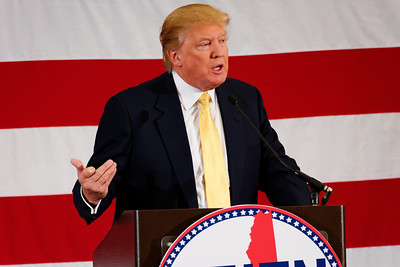
President Donald Trump announced a sweeping trade ultimatum against Iran and its global business partners, warning that any country dealing with Tehran will face a crushing 25 percent tariff on all U.S. trade.
The president declared the move immediate and irreversible economic strike as Iran reels from violent nationwide unrest and mounting international pressure.
“Effective immediately, any Country doing business with the Islamic Republic of Iran will pay a Tariff of 25% on any and all business being done with the United States of America. This Order is final and conclusive. Thank you for your attention to this matter!” Trump wrote in a Truth Social post.
The order places foreign governments on notice that commercial ties with Iran now carry direct economic consequences in Washington, escalating U.S. leverage at a moment of growing instability inside the Islamic Republic.
"Effective immediately, any Country doing business with the Islamic Republic of Iran will pay a Tariff of 25% on any and all business being done with the United States of America. This Order is final and conclusive…." – PRESIDENT DONALD J. TRUMP pic.twitter.com/UQ1ylPezs9
— The White House (@WhiteHouse) January 12, 2026
Trump’s announcement landed as Iran entered its fifteenth consecutive day of unrest, with protests spiraling across cities and security forces responding with lethal force, according to multiple human rights groups.
Iranian Foreign Minister Abbas Araghchi insisted Monday that the uprising had been contained, claiming the situation was “now under total control,” even as reports of mass casualties continued to surface.
Independent estimates of the death toll have varied, with the Human Rights Activists News Agency reporting that at least 496 protesters have been killed, along with 48 members of Iran’s security forces, while roughly 10,600 people have been arrested during the last two weeks.
Iran Human Rights, a Norway-based group, cited unverified reports suggesting the number of dead could exceed 2,000 since authorities began cutting internet and mobile access in an apparent effort to conceal the scale of the crackdown.
“The massacre of protesters occurring since the 3rd, especially after the nationwide internet shutdown, may be far more widespread than we can imagine,” remarked IHR director Mahmood Amiry-Moghaddam. “The international community must mobilize all possible means to stop this.”
Trump’s warning could ripple through major economies with existing commercial ties to Iran, including China, Brazil, Turkey, and Russia.
As the situation deteriorated, U.S. officials urged American citizens inside Iran to leave immediately.
A security alert issued by the virtual U.S. Embassy for Iran instructed Americans to “leave Iran now” and cautioned them to prepare departure plans that do not rely on U.S. government assistance.
“Protests across Iran are escalating and may turn violent, resulting in arrests and injuries. Increased security measures, road closures, public transportation disruptions, and internet blockages are ongoing,” the alert warned.
“The Government of Iran has restricted access to mobile, landline, and national internet networks.”
The advisory urged U.S. citizens to anticipate prolonged communication outages and to consider exiting Iran by land through Armenia or Türkiye if conditions allow.
The growing turmoil has also triggered open discussion inside the Trump administration about potential military responses, according to White House officials.
Press Secretary Karoline Leavitt confirmed Monday that the president is keeping a full range of options available as Iran intensifies its crackdown.
.@PressSec on Iran: "I think one thing @POTUS is very good at is always keeping all of his options on the table… Diplomacy is always the first option for @POTUS… However, with that said, @POTUS has shown he's unafraid to use military options if and when he deems necessary." pic.twitter.com/7Cy2rYp6Nc
— Rapid Response 47 (@RapidResponse47) January 12, 2026
“I think one thing President Trump is very good at is always keeping all of his options on the table,” Leavitt told reporters.
“Airstrikes would be of the many, many options that are on the table for the commander-in-chief. Diplomacy is always the first option for the president.”
She suggested Tehran’s public messaging is distinctly different from private communications received by the administration.
“He told all of you last night that what you’re hearing from the Iranian regime is quite differently from the messages the administration has received privately,” Leavitt said, adding that Trump remains willing to explore those channels.
“However, with that said, the president has shown he’s unafraid to use military options if and when deemed necessary,” she continued. “Nobody knows that better than Iran.”
Trump himself confirmed that Iranian officials have reached out in recent days, signaling interest in negotiations even as violence persists.
.@POTUS on Iran: "We're looking at some very strong options… I'm getting an hourly report, and we're going to make a determination very soon." pic.twitter.com/XnDOCZSMpv
— Rapid Response 47 (@RapidResponse47) January 12, 2026
“There seemed to be some people killed that aren’t supposed to be killed,” Trump told reporters Sunday.
“But we’re looking at it very seriously. The military is looking at it and we’re looking at some strong options and we’re going to be making a determination.”
He indicated that talks may still occur, though events on the ground could force faster action.
“We might meet with them. A meeting is being set up, but we may have to act because of what is happening before the meeting, but a meeting is being set up. Iran called, they want to negotiate,” Trump said aboard Air Force One.
Trump also revealed that Iran contacted him regarding its nuclear program, a subject that continues to loom over the broader standoff.
U.S. strikes against Iranian nuclear facilities in June delayed Tehran’s program by at least two years, according to the Pentagon, a fact that remains central to the administration’s posture.
Iran’s leadership has publicly struck a defiant tone despite outreach signals.
Araghchi said Tehran is open to negotiations grounded in “mutual respect” while simultaneously warning that the country is prepared for armed conflict.
“We do not want war, but we are completely prepared for it — even more prepared than before the previous war,” he told foreign diplomats during a meeting in Tehran.
“The reason is clear: the best way to prevent war is to be prepared for war, so that our enemies do not once again fall into miscalculation.”
Behind the scenes, Trump is expected to receive updated briefings from senior national security officials as the administration weighs next steps.
The Wall Street Journal reported that discussions are scheduled for Tuesday, focusing on potential responses to Iran’s violent suppression of protests.
Support for tougher action has also emerged from unexpected corners on Capitol Hill.
Sen. John Fetterman of Pennsylvania said he would back military action against Iran if the administration determines it is necessary.
“Sure, absolutely,” Fetterman commented on CNN. “If it continues to make more sense, absolutely. I think I was the only Democrat that fully supported our strike of their Iranian nuclear facilities last year.”
🚨 NEW: Senator John Fetterman BREAKS RANKS with Democrats to support President Trump taking military action in IRAN to protect the protestors pic.twitter.com/ys33osDkHy
— TV News Now (@TVNewsNow) January 12, 2026
He argued that prior strikes prevented Tehran from advancing its nuclear ambitions.
“Without those kinds of strikes, Iran could have acquired a nuclear bomb. I hope we can all agree that Iran should have never acquired a nuclear bomb,” the Democrat continued.
Fetterman framed the current unrest as an opportunity to confront what he described as a destabilizing regime.
“Iran is one of the world’s top terrorist [underwriters], and now you have that poisonous regime now in spiral — so why wouldn’t we want to support that and those brave protesters?” he added.
“They’ve killed probably more than 600 by now, so now, why [wouldn’t] we want to have the kinds of targeted kinds of action that could break that regime?”
He reiterated his position later in the interview. “I don’t know why we can’t all want to support that, to back them and now bring that awful regime to its knees,” Fetterman noted.
“They’re so desperate. Now they’ve killed the internet, and now they’re mowing down their own citizens,” he added. “I think we can all agree that the world would be better, safer and more just if you could break that regime.”

Yes needed